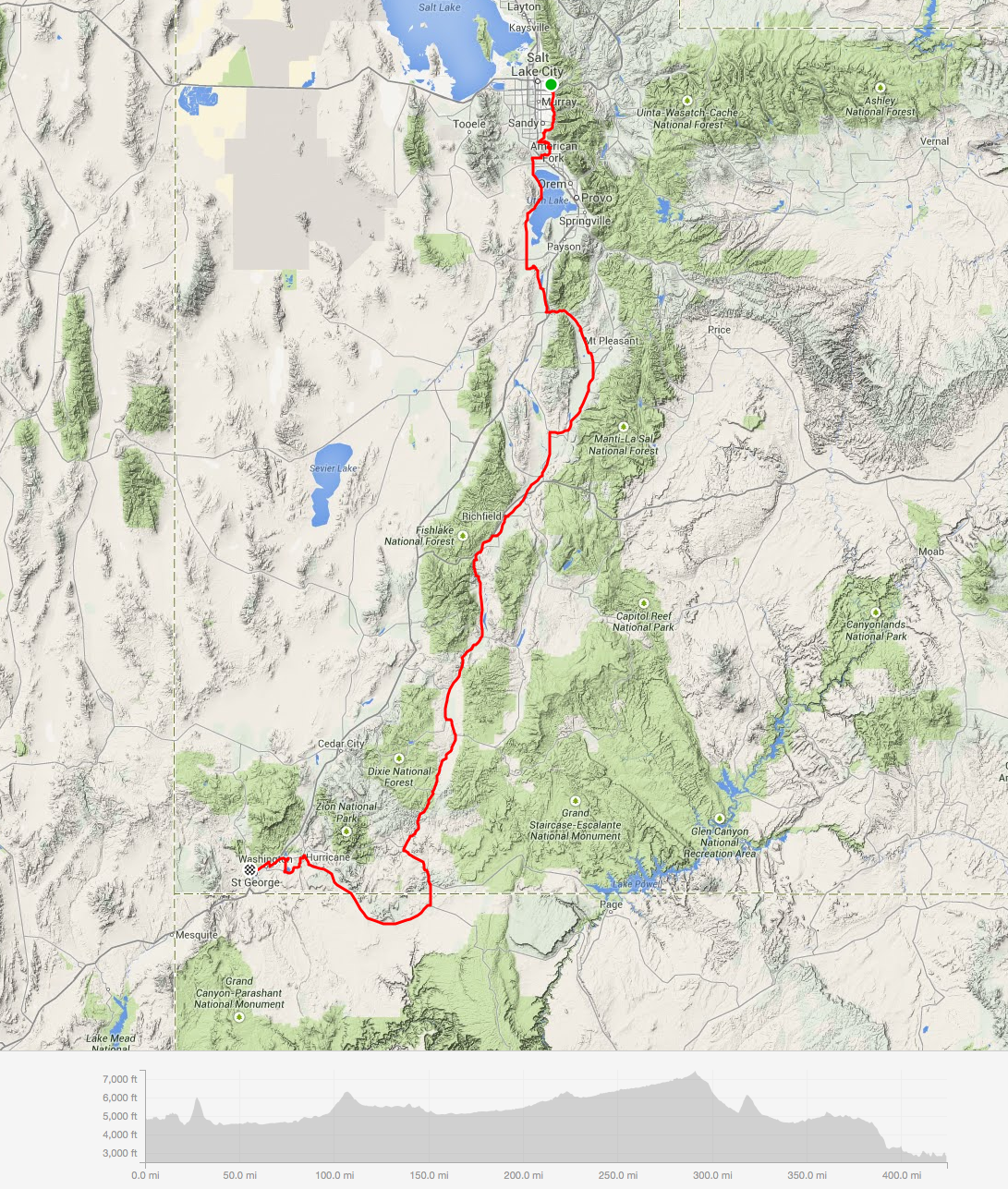
In 2014 I got the idea to ride in a local 420-ish mile relay race, except NOT doing it relay style, but riding in the “solo” category. Salt to Saint is the name of these event which goes from Salt Lake City to Saint George Utah. Unlike many multi-day events outside Utah, this one did not conflict with Sunday, so I decided to give it a try, starting on Friday, September the 19th. Unlike some other relay races, this one allowed aerobars, something I use a lot on long road rides. Having done several longer brevets this summer, I knew what my average speed is for events lasting 400 to 600 km (250 to 375 miles) and I figured I could easily finish within the 34.5-hour cut off time.
I organized a crew, and, as mandated by the organizer, I needed two crew-support drivers for the night section, but only one during the day. My local cycling friend JB Harward consented to drive the first section from SLC to Sanpete County, where we live. For the balance of the ride I got help from two other local friends: Paul Hart (who introduced me to the ultra-endurance world of running) and Frits Tessers (an all-around guy that knows a little about lots of sports). I picked up my packet and these monster car stickers the previous night.
All the solo riders started at 8:00 a.m. JB was more nervous than I as he doesn’t know Salt Lake and managed to get lost, trying to follow the route. Early in the ride, there was a big climb up and over Traverse Ridge, so I started off with with my carbon-fiber bike, as it is lighter, due to no aerobars and a lighter-weight saddle. JB and I hooked up at Transition Zone two, some 33 miles into the course. At that point, I switched to my Seven Titanium bike which had aerobars and off I went to make the distance around the west side of Utah Lake. JB met a local friend there (Russell) there, who rode with him (in the car) for the rest of the trip to Sanpete County. I was not able to find other riders that were close to my speed when making my way around the lake, so I ended up soloing the whole thing. As I entered Juab County (near Nephi) I did find some help for perhaps 8 or 10 miles, and that was nice.
From there I climbed up Salt Creek Canyon to the slightly cooler temps of Sanpete County, where I live. JB & Russell met me at the transition zone in Fountain Green (mile 111), after which he left to switch crews. My next crew caught up with me near Manti at about mile 139. I rode all the way down US-89 and the we actually had a slight tail wind coming into Salina, which is atypical. It was nice going 22-25 MPH during much of that section. I also was able to draft off another relay rider before I flatted just outside Salina. I texted my crew who were nearby, and quickly come to my rescue, switching out wheels.
I was surprised how few people I was able to draft with. There were about 490 registered riders, but only 9 doing the solo version (7 finishers). The starts were staggered, based on your predicted finish time. When I did come upon another rider I would quickly mention to them I was a solo rider and they all let me “suck their wheel” as they were only going around 16 miles for each leg (unless they were doing double legs). But honestly, that only happened about 4 or 5 times for a few miles each.
As nightfall came, I added on my lighting gear and reflective clothing. This was just as I was entering Richfield at about 7:00 p.m. (mile 181). From there I continued to ride my Ti bike until we got into Hatch (mile 279), which is near the base of a long, slow climb up to a place called Long Valley Junction. There I switched bikes and stayed on my carbon bike the balance of the ride. One section of the roads was wet from rain, but it had happened just before I arrived. The high that day was in the mid 80s — perfect cycling temps. The nightime temperature at Hatch was a warm 48F, but it felt much colder to me due to my fatigued state. Consequently, I put on my winter soft shell jacket and neoprene booties, as well as some warmer mountaineering gloves (having a crew close by was wonderful!). There as a slight head wind for most of the night. Cycling down US-89 at night was great! No, really. Aside from the support crew cars & RVs, there were very few vehicles. Earlier this year I did another ride (a long brevet, which I organize), going down US-89 during the day, and we were weaving in out of the rumble strips as vehicles approached us. It was tedious. On Salt to Saint, my crew choose to shadowing me (driving slowing behind me with their flashers on), which kept me alert and moving. There were unbelievably helpful during this whole ride.
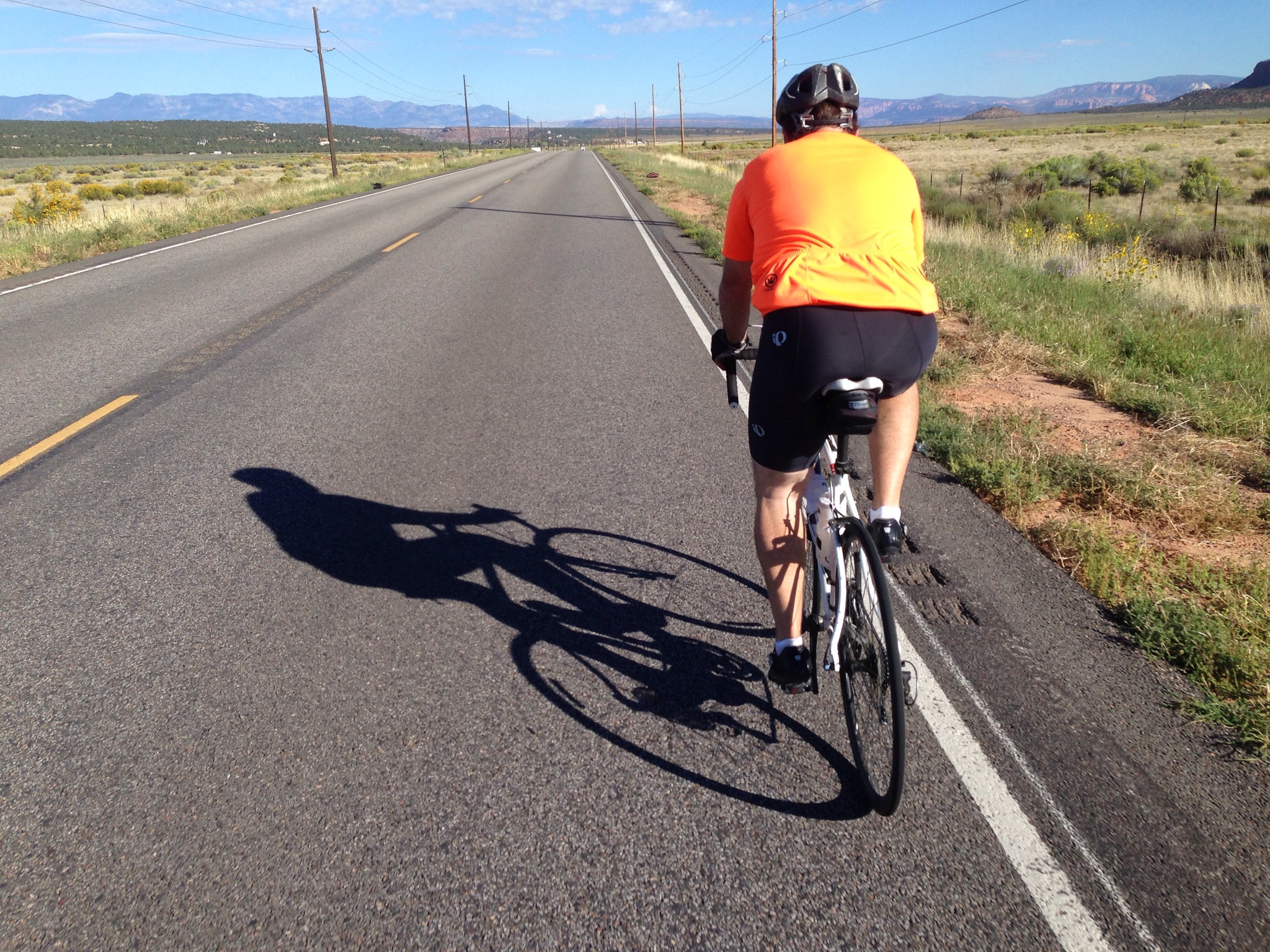
I finally arrived in Kanab at 6:00 a.m. (mile 332) and although my crew had a lot of food in the car, I wanted something hot, so we stopped into the local McD. The service was slow as there was also were a couple of 4-man crew trucks with riders going through the drive-thru. While waiting for my food, I rested my head down against the table and got a 5 or 10-minute power non-sleep “nap.” Dawn was just beginning to break as we left Kanab. I still had on all my warm clothing, finally removing it as the morning went. I quickly arrived into Fredonia Arizona, after which there is a long gradual climb to Colorado City. This section of the highway had a decent shoulder outside the rumble strips. But as soon as we entered Utah, the shoulder shrunk down to nothing (see photo). Here my crew shadowed me again, plus I got a free draft from another relay cyclist. We dropped into Hurricane Utah and it was now getting pretty warm. It was 10:30 a.m. I removed all my extra clothing. I realized that with my remaining mileage, I would not be able to achieve my goal of a sub-28 hour ride, but pushed on hard anyway. I went straight through for the next 31 miles (much of it had a bunch of short climbs) without any additional hydration from my crew, arriving at the finish at 1:41, yielding a final time of 28:41.
Overall, the neutral support was OK, but I only used it once their services once to top off my bottles and another time using their porta-potty somewhere along US-89 in the middle of the night. Most of the transition zones were about 18 miles apart — I usually stopped at every other one to top off my bottles or switch out clothing. Some of these areas has porta-potties and others had none (that I could see). At the finish line, their was fresh cut watermelon, pizza and sodas/or bottled water. Because this was a “race,” I took few photos so I could keep moving quickly.
Here is the link to my Strava GPS upload. Official results are here (click on Leaderboard) or on this page.
Upon arriving at the finish, Clay, the organizer, indicated that to date (since 2010?), I’m the oldest cyclist to complete this ride in the solo division (age 60). Hurray — an unofficial course record!
Gear Tested: As a bag designer and owner of a niche-market online cycling store (eoGEAR), I’m always testing new gear.
– I had just picked up a new tail light, 1-watter, called the Radbot 1000, by Portland Design Works. I had it mounted to my seat stays. Additionally, I had a 1/2-watt Sigma Tail Blazer attached directly to my ankle. My drivers reported that this combination was “hands down” brighter than any other tail light combo they saw that night!
– Accelerade. I have used Hammer Perpeteum for many of my longer rides as it contains the “magical” mix of 4:1 carbs/protein (most sports drinks have no protein) — but I am not crazy about their flavor choices, so I decided to try Accelerade in tropical punch. That flavor was reasonably tasty…more so than the Cytomax tropical punch, so I most likely will c0ntinue using this product on future riders longer than three or four hours.
– Cocoanut Macaroons. Not everyone likes food with cocoanut. But I love it. And Bicycling Magazine suggested it. Everything we read is true…right? So I tried them and loved them. They are less messy than fig newtons and are less prone to drying out. I shoved four or five of them in the Fuel Container in my eoGEAR Top Tube Century Bag for easy access. Are they a good source of nutrition during an ultra-endurance event? Beats me. Sometimes, just any calorie is a good calorie.



 Rando Richard Blog
Great job, Richard! Sounds like you had a great ride. You are an animal!
LikeLike
Hey Richard,
Nice job and congrats on a fantastic accomplishment.
Ride on,
Mark
LikeLike
Richard,
Great job on the finish. Hope to see you next year. I didn’t see a relay team until 240 miles into the race. Don and I rode alone until Nephi and then I let him go. The guy was an animal and I needed to ride my race. He rode alone until T22. Check out my story from Saints to Sinners on my team blog. http://cicadacycling.com/mike-conti-shares-his-saints-to-sinners-experience/
Hope to see you next year,
Mike
LikeLike
Awesome result! Considering all of the pauses and such necessary for a solo rider your time is awesome. What was your average on the bike speed? Or did you not keep track of that?
LikeLike
Average speed on the bike was 16.6 MPH. It appears that I spent almost 3 hours off the bike, which is a lot more than I would have thought (though we had terribly slow breakfast service at McD in Kanab, the only food place I stopped to go inside). Specs are here from my Strava download. Funny thing, when I did the 200-mile LoToJa race a few weeks earlier, I only spent about 20 minutes off the bike (but I didn’t have to fiddle with clothing layers as I did on S to S).
LikeLike
Good read. I did this as a relay in 2012 (Sons and Brothers). It was fun. cannot imagine doing it solo. Frits is an old friend of mine from Orange County in days of yore.
LikeLike
Yes, Frits is quite the guy. He also helped me the following year on a longer solo effort — Salt to Sinners.
LikeLike