Lactate or Anaerobic Threshold

Recently I posted a question on a cycling forum. It was “how high should one’s heart rate be on a long extended climb?” Then general consensus was “try to keep it below your lactate threshold” or “don’t go into the red.” (Lactate threshold is also called anaerobic threshold or maximal steady heart rate.) I know what my maximum heart rate is, but my LT is subject to discussion. In the many fitness books which I have read, there are several methods for determining this. But none make as much sense, and are as easy to calculate as this technique by John Hughes (author of the book Distance Cycling), who posted the following comment (used with permission):

Lactate threshold is the level of exertion at which you start to accumulate significant amounts of lactate in your blood.You can get tested in a physiology lab—they put you on a trainer, increase the wattage every 3 minutes and take blood sample every 3 minutes. The equipment plots HR vs lactate concentration and at some lever there is an inflection point where lactate concentration starts to increase more rapidly.

There are several field protocols for estimating LT.  I have clients warm up thoroughly and do a 30-minute TT [time trial]. I’m on the road, but if I remember correctly Friel* suggests a 30-minute TT and the average HR for the last 20 minutes is close to LT.  Two keys:

1.  warm up thoroughly including about 5 minutes at close to what you think is your LT and recover for about 5 minutes

2.  try to ride the TT at very close to the same intensity throughout

If you do this in competition average HR for the 30 minutes will be about 103% of LT.

LT ranges from 70-90% of max HR depending on fitness.  I usually have clients do the test early spring and then repeat every 4-6 weeks using the same course. This way we can check fitness—increased speed and perhaps change in HR.

You can train to improve your LT by doing either intervals or more random speed work. Longer efforts below LT + recovery are more effective than shorter efforts above LT. Speed work above LT takes more recovery time before the next quality workout so you get less total quality volume in a week.  How much?  Start with 30 minutes of mixed intensity, broken into X hard efforts totaling about 15 minutes and Y easy efforts also totaling about 15 minutes.  Build to 45 minutes of mixed intensity (or 60 minutes if you like pain!)

LT varies by sport because of the different muscles involved so if you really want to train using HR zones based on LT, then you need to do separate tests for different sports. Running is weight-bearing, cycling and swimming aren’t. Swimming and XC skiing use the arms.  Etc.

When I say don’t go into the red when climbing (or ever unless in a road race), I mean stay below LT. If you are fit you might be able to attack a climb at 95% of LT and hold that to the top. Or you might start @ 95% of LT and back off slowly as you climb. Or start a little lower and push a little harder toward the top.

LT isn’t really a “point” where all of a sudden you go anaerobic, but it’s a region where you start accumulating more lactate with increasing metabolic costs in terms of fuel efficiency as I said in the earlier post. So it’s better to climb steadily at 95% of LT instead of starting up at 90% of LT and ramping up to 100%.

I’ve written an eArticle on Intensity training which is for sale for $4.99 at RoadBikeRider.com:

http://www.roadbikerider.com/e-articles/intensity

Huffa, puffa!

John

www.coach-hughes.com

* Joe Friel, author of the Cyclist‘s Training Bible. Per Joe’s blog, he says:

To find your LTHR do a 30-minute time trial all by yourself (no training partners and not in a race). Again, it should be done as if it was a race for the entire 30 minutes. (If you really are using a race then it needs to be about 60 minutes duration. The reason for ths is that you go harder when in a real race – about as hard as you would go for 30 minutes alone.)  At 10 minutes into the 30-minute test click the lap button on your heart rate monitor (in a 60-minute race don’t worry about this). When done look to see what your average heart rate was for the last 20 minutes. That number is an approximation of your LTHR. Note: I am frequently asked if you should go hard for the first 10 minutes. The answer is yes. Go hard for the entire 30 minutes. But be aware that most people doing this test go too hard the first few minutes and then gradually slow down for the remainder. That will give you inaccurate results.

As it turns out, my maximum heart rate on a bike (this year at the age of 58) is 161 or 162. When backcountry skiing, I get a slightly higher amount. Using the above formula, my LT is about 138, which is 85% of my maximum. According to Edmund R. Burke, PhD, “Most elite cyclists reach their lactate threshold at 85 to 90 percent of VO2 max, whereas untrained individuals reach theirs at 50 to 70 percent of VO2 max.” (p. 29 or the 2nd Edition of Serious Cycling)

Also, check out this page on my blog about how to measure your maximum heart rate.
Post Workout Smoothie Recipe

For the past year I have concluded nearly workout (both cardio and strength-training) with a protein fruit smoothie. I got the original recipe from Boys Life, the BSA magazine for youth. It was a simple recipe, which I have since modified slightly. Here it is:

  • 1 to 1.5 fresh bananas
  • 3/4s of a fresh orange (I just eat the other quarter on the spot!)
  • 1 handful of frozen spinach (I smash them fresh into a Tuperware container and put in the freezer. I then break off portions as needed — yeah, no more spoiled spinach in the fridge. Spinach is one of those super foods, yet adds little to spoil the sweet fruit flavor. Thanks Jason Quinn for this great idea!)
  • 1 handful of frozen blueberries (I personally like the flavor better of straight blueberries compared to the Tri-berries blend I previously eat.)
  • 1/2 cup of soy milk (I used to use plain yoghurt but have switched due to my vegan tendencies of late)
    Put all of the above in a blender and mix. *Then add…
  • 4-5 frozen Costco/Kirkland jumbo-sized strawberries
  • 3-5 ice cubes
  • 1 scoop of protein powder (soy isolate preferred or sometimes I use whey, usually about 20-25 grams of protein)
  • 1 tablespoon each of cold rolled ground flax seed and wheat germ (I combine them in equal quantities ahead of time and keep them in a airtight container)

*I don’t put in the strawberries or ice initially as they tend to rattle around in the blender, making racket and straining blender  (my “unbreakable” polycarbonate  blender pitcher has a crack in it from placing frozen strawberries in as the first ingredient). I also don’t add the powder ingredients til the end, otherwise they end up at the bottom of the blender and are not consumed.

Sinking Legs while Swimming

Here it is February and I have been consistently swimming since November of last year (2 – 3x a week). On my last post I reported problems with bi-laterial breathing. I have finally settling into breathing on one side, every other stroke (instead of every third stroke as with bi-lateral), BUT I switch sides every 25-yard lap.

It seems my times for a mile are still rather slow, despite having plenty of endurance (42-47 minute miles). Last week, I asked the student coach at my pool to evaluate my kick technique. She said she noticed that my legs were sinking more than they ought to. Per her suggestion, I took a small paddle board and worked on kicking. Oddly enough, I still was not able to get my feet out of the basement…they just sink, causing a ton of drag (despite dropping my head down in front of me with the paddle board in my outstretched hands). After reading this site, I suspect my problem might related to my age-old ankle injury. My left ankle ankle, despite weeks of physical therapy, does not flex more than 10 or so degrees. Because I cannot point my toes, this could be causing a ton of drag, slowing down my overall performance.
Per this site, Karli Wilkinson says “In freestyle swimming, having flexible ankles can be a key part of your kick mobility. Increasing flexibility in your ankles allows your feet to act like flippers and gain more propulsion in the water.”

Hmmm….not much I can about that. In fact, at one point, I was considering having my ankle fused to reduce the pain when walking or hiking.

Swimming & Breathing

This fall, because it is too cold to cycle comfortably, and since there is not enough snow to ski, I have decided to try swimming for part of my cardio workout (I also visit the weight room). I have been going to the local college pool where I have been receiving lessons from a student there (Kamie at Snow College). As an adult I have never received formal lessons, so this is basically starting from scratch. She (and most other coaches) recommend bi-lateral breathing, or breathing from each side, i.e. taking a breath every third stroke. I can do the bi-lateral breathing OK, except that after a lap or two (25-50 yds), I just feel like I’m not getting enough air to swim continuous laps. I’m wondering, as a 57-year old, should I be breathing more often, like other second stroke? Below is some research I did online regarding this topic. Type bolding was added by me.

1 • Excellent video on breathing by Michael Phelps coach

2 • http://www.osbmultisport.com/articles/onesidebreathing.html > Bilateral is for shorter events only

3 • http://www.olympicswim.com/bilateral-breathing-should-you-breathe-to-both-sides-in-freestyle-swimming/ > Breath from both sides, but go a whole lap on each side before switching

4 • http://forums.usms.org/archive/index.php/t-15701.html > This guy has similar comments to what George Andersen said to me recently. “sjsturat” on this forum said:
“My solution is to do the majority of my practice yards breathing bilaterally, switching to breathe every two strokes only when the pace gets fast enough that breathing every 3 would limit my ability to hold the speed. Then in a race, I breathe every two. Those 1650 yards of lopsided breathing aren’t going to destroy my stroke, but the lack of oxygen would hurt my time.”

So no, I don’t practice like I race. I guess the bilateral breathing in practice is like a constant, low-grade drill.

5 • http://h2oustonswims.org/articles/breathe_how_often.html > “So, in training, while I do want swimmers practicing excellent breathing technique on both sides I encourage breathing on the left for this lap and on the right for the next lap, or perhaps breathing on the left for 200 and on the right for 200, and so on.”

6 • http://www.swimsplit.com/ssa1.htm > An excellent one-page primer. “Also, you should hold the air in your lungs until the moment just before your mouth breaks the surface. If you blow air out the whole time your face is in the water you may feel the need to inhale before you actually can. You’ll also lose buoyancy. So for most of your stroke you’re holding the air, then exhale-inhale just before and just after your mouth is above the waterline.” “If you need more oxygen than you can take-in every third stroke, breathe every second stroke and switch sides often.”

7 • http://www.totalimmersion.net/forum/archive/index.php/t-1512.html see “terry” > Finally, something online about older people and their breathing rate:

“At age 30 I could breathe every 5 or 7 strokes – if necessary. At age 40 I could breathe every 4 strokes – if necessary.
Nine months short of age 60 I can breathe every 3 strokes in the pool if I stay very relaxed. If I add any effort I need to breathe every 2.
Like CMP I pretty religiously breathe to the right on odd lengths and the left on even lengths.

In open water, with flip turns removed, I can swim a pretty brisk pace for a good long time, breathing every 3, but increase breathing frequency as needed by doing
2R2L
3R3L
4R4L
etc.”

Here’s one comment debunking bilateral every 3 stroke swimming…RobM77 said
“Assuming we’re talking purely about longer distance swimming (100m+), bilateral breathing is my preferred breathing pattern. However, my [very good] TI coach tells me that breathing every stroke cycle to one side only (i.e. every time the left arm recovers, you breathe; then swap after a length to the right etc) is the best way to swim. Apparently it’s been scientifically proven that the advantages of more regular intake of air outweigh the disadvantages of breaking one’s streamlining slightly. In addition, when one breathes to a ‘new’ side, the head is inclined to lift higher, whereas after two or three breaths to one side you become better at it (short term muscle memory).”

8 • http://www.virginactive.co.uk/active-matters/articles/exercise/open-water-swimming > Doesn’t this comment contradict the comment # 5 above?
“Master bi-lateral breathing…Not exhaling fully is one of the most common reasons for running out of oxygen.”

9 • http://www.livestrong.com/article/415452-how-to-breathe-during-triathlon-swimming/ > “Exhale your entire breath through your nose while your face is in the water. You should continue to exhale through your nose until you lift your head out of the water for another breath.”
“You should continue to exhale through your nose until you lift your head out of the water for another breath.”

10 • http://forum.slowtwitch.com/gforum.cgi?post=3414931 > Excellent comments “I’ve coached college swimmers and triathletes with the advice of bilateral breathing.” “The pattern is too long as an interval. Most triathletes try “breathing every 3rd”, which means something like “right breathe, left stroke, right stroke, left breathe.” This is too long between breaths and compromises aerobic capacity.” “I still “come home to mama” and breathe right-sided when a pool race gets intense or in the longer reaches of a tri swim.” “My advice: find videos of the 2008 Olympic Open Water swim or any of the major triathlons, or the 1500m pool swims. You’ll see that these swimmers are breathing bilaterally. The difference is that they breathe one side for a long stretch of strokes and then breathe to the other for a few strokes. They do this to maintain aerobic respiration and balance and sighting. Breathing every third is great for moderate warm-up or practice pace, but not for competition.”

11 • http://forums.usms.org/showthread.php?t=14732&highlight=breathing
“If you run out of breath and can only do 1-2 laps it’s not because you don’t have endurance. It’s because you are swimming a wrong technique.
When I started with freestyle I was already swimming breaststroke for a year or two.
I was also a good cyclist and had a high endurance but still could only manage 1 lap and then I was totally out of breath.
Swimming with a pull buoy helped a lot.
You need to find the right body position. Don’t worry. You will eventually be able to swim 4 laps, then 10 and all of a sudden 100.”

12 • http://forums.usms.org/showthread.php?t=14505&highlight=breathing
“2) The first thing I ask swimmers to work on is to NOT exhale powerfully and completely empty out their lungs when they push off the wall and/or on the breakout after a turn. Rather use a slower/controlled release.
3) On the first arm stroke/breath I find that have a small amount of air left that I exhale quickly/forcefully just as my mouth reaches the position of taking a breath…it has the effect of clearing water as well as that last bit of depleted O2.
4) The inhale is not a long/slow/deep process but rather a fairly quick and somewhat shallow inhale the length of which should be determined by your arm tempo/speed vs. the other way around.
5) At lower speeds I actually hold my breath for what is probably about 1 second in the stroke cycle and begin a controlled exhale as my opposite arm cycles into it’s entry phase.”

13 • Swim Smooth is an excellent site if you are looking for “how to videos,” although I didn’t see any videos on flip turns.

The Whiter the Bread, the Sooner You’re Dead

When I was growing up, my mother and many of her sisters (she came from a family of 15 siblings), espoused a good diet to increase one’s health and/or to increase your lifespan (several of them published books on this topic). They had a slogan, which I’ll never forget, which is “The Whiter the Bread, the Sooner You’re Dead.” I was brought up on homemade apple sauce and whole wheat bread. Wonder bread was a big no-no in our home.

Although I’m nearly 60 years old, and despite participation in many cardio-intensive endurance sports, I still have a moderately high cholesterol (total of 246 in the summer of 2011), which is most likely is due to my “bad genes.” I take 10mg of Simivistian (sp?) daily to bring it down below 200.

In September a CNN special ran that REALLY got my attention. Featured on the show was Dr. Cardwell Esselstyn. Since then I have purchased and read three compelling books on this topic, written by him, his son and another colleague. They are The China Study (recommended by my brother Karl), The Engine 2 Diet and Prevent and Reverse Heart Disease.

Essentially they preach that much of the western world is dying from “Diseases of Affluence” like cancer, diabetes and coronary heart disease (a diet which is loaded with dairy, meat, refined or packaged foods). On the other hand, those living in less developed countries are dying of “Diseases of Poverty” which includes pneumonia, pulmonary tuberculosis, rheumatic heart disease, diseases of pregnancy etc. (diseases which we have all but eliminated in the West). The diseases of affluence are almost unheard of in many of these less developed countries. Their diets, especially in rural China, where this study took place, are a stark contrast to ours. It includes raw foods, beans, veggies, whole grains with minimal meat or poultry. (See the book The China Study, p. 75-76 for more detail). This book says “Here in America, we are affluent, and we die certain deaths because of it. We eat like feasting kings and queens every day of the week, and it kills us” (p. 109). These authors claim that a vegan diet may reverse many types of heart disease and lower your cholesterol. The goal is to bring one’s total cholesterol below 150 (according to most US physicians, anything under 200 is considered OK) and LDL or bad cholesterol below 80.

Since then I have made some household changes in my diet. I have dumped nearly all dairy from my diet and have cut my meat intake to maybe once a week. I have increased my veggie intake a lot and have made an attempt to reduce my tendency to inhale sugar (ice cream and chocolate are my shortcomings). So far, I eat more often (grazing) and I even have evening snacks so I never go to bed hungry, yet I’m still maintaining a decent body weight. (Previously, while on my diary-rich diet, I would try to not eat much of anything after 8 p.m. in an effort to keep my weight down). The purpose of this radical diet change is NOT to lose weight, but rather to bring down my cholesterol, reduce any possibility of heart disease and possibly increase my VO2 Max (my ability to use oxygen during athletic events).

I plan to get my blood retested next spring to see if these plans works. Stay tuned. May 2012 Update: After about 90 days on a fairly strict vegan diet, my total cholesterol dropped 2-3 points. Disappointing — I’ll test it again later this fall perhaps.

Here is a note I posted on a recent family blog about the topic of healthy food and a vegan diet. “CONVENIENCE: We are a society of convenience and speed. We have fiber optic internet, G4 phones, 75 MPH speed limits, 8 frames-a-second cameras, ultralight bicycles that go faster, faster dual or quad-core CPUs and yes, super-convenient food. I’m not talking the typical drive up “fast food,” but packaged food at the local grocery store. As I taught & demonstrated to a scout youth group last week: a fresh orange is better than a Fruit Rollup. A whole grain sandwich with PB and honey is better than a pop tart etc. BUT real food is messy and requires preparation. We are too hurried to pause and prepare the real McCoy. Pay someone else to prepare it and stick it in box. It goes beyond vitamins as real foods have cleansing properties that, according to many sources, reduce the probility of many “Western” diseases.”

2011 Training Notes

April 23—
20 mile solo time trial, MP>Moroni>Chester Loop (about 500 vert. gain).
Cross bike and no aerobars.
Time: 1:03:57 after a warm up
Max HR: 162
Average HR: 140
Time spent in each zone: 87%/13%/0%

HR Zones (max set for 165 on Sigma PC15) = Power Zone (100-80%) 165-131, Fitness Zone (80-60%?) 132-115, Health Zone (60-0%) 91-0.

June 4-5th—
Grand Canyon 600K
First climb of the day, heart sustained at 150, 140 pushing on flats
Later in day, HR on climbs: 140
Second day, max. HR on climbs: 115 & maybe 120
Training time: 26:58?
Total Calories: 10,638?
Total measured HR time: 85:48
Max HR: 154
Average HR: 110
Time spent in each zone: 15%/21%/49%
Riding time: 26:21
Aver speed: 14:33
Max speed: 48.10
Distance: 377.9

Leg Length Inequality


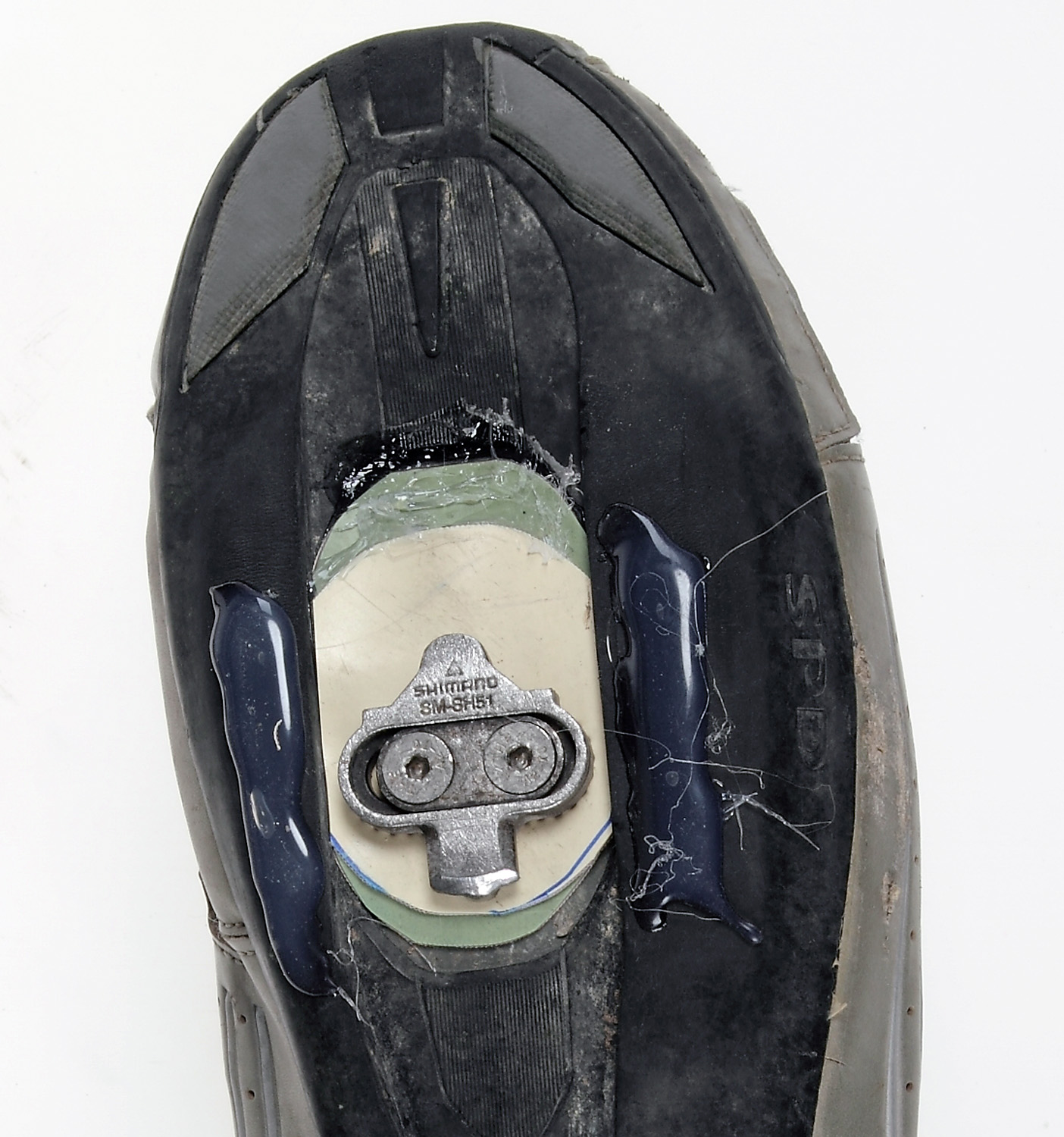
Homemade shim for my MTB cleats on my Shimano “Touring” shoe. I also put strips of hot glue on the side to elevate the sole of the shoe.

During the 2010 cycling season, while trying to find the ultimate saddle for cycling, I constantly had chafing issues, but ONLY on my right side, just forward of my sit bone. After reading Pruitt’s Complete Medical Guide for Cyclists about leg length inequality (p. 69), I had my legs measured. I went to a trusted friend, who is physical therapist. Using a tape measure he determined that my left leg was 10 to 15mm  (1/4 to 3/8″) shorter than my right leg. That seemed to make sense, as my left ankle is my “bad” ankle that has suffered a major break in a mountaineering accident (1984) and has had subsequent surgeries, including a bone graft to build up the length of the leg. But would a shorter left leg contribute to soreness on my right side? Weird.
Since then, I have shimmed up my left shoe. I first used  a custom orthitcs in my left shoe only, which gives me a little more lift than the stock insole which I have in my right shoe. Initially I used a couple of sheets of HDPE (plastic), but the cleat kept rotating loose, so now I have placed two layers of 1.5 mm semi-firm rubber there (used on drafting tables as cutting pads). Pruitt suggested that you shim up only half the distance of your LLI and then, only if your LLI is more than 3mm.

Time will tell. Meanwhile, I am in the midst of testing various saddles, to it may be hard to tell if this made much difference.

Why Tall Cyclists (like me) Suck On Climbs

This confirms why sometimes I get blown away on the climbs by cyclists, usually much shorter than I (I’m 6-3). This all has to do with the fabled power to weight ratio (or strength to weight ratio) for those of us that participate in anti-gravity endurance sports like trail running, mountaineering, cycling and backcountry (rando) skiing.
I just reviewed the 2010 photos of the solo winners of a tough 500+ mile race in Utah, called the HooDoo 500 (thinking of entering it this year). Sure enough, the winner (by a landslide) was a short, little thin guy.
From the 1/2/7/2011 issue of RoadBikeRider.com

2. COACH FRED

Why Can’t Climbers Go Faster on the Flats?

Q:  Why is there such a separation between riders who can climb well and those who are strong in time trials or other flat races? I don’t understand why most strong climbers can’t go fast on level roads, or why powerful sprinters suffer so much in the mountains. — Barry M.

Coach Fred Matheny Replies:  It’s simple mathematics, Barry. The answer involves body weight, power output and wind resistance.

On flat roads, speed is primarily restricted by the wind resistance created by the front of a rider’s bike and body.

Big riders in a low racing position don’t have a frontal area drastically different from that of smaller riders. But big riders do tend to generate more power thanks to their larger muscle mass. That’s why time trials and sprints — typically on flat or rolling terrain — generally favor rangy, muscular riders.

However, as soon as the road tilts up, the advantage shifts to smaller cyclists, even if they produce less power.

A rider must fight gravity when going uphill, so climbing requires a favorable power-to-weight ratio. The more watts a rider can produce for his (or her) body weight, the faster that rider can climb.

So here’s the bottom line: To improve climbing, you must either lose weight, increase your sustainable wattage — or do both.

This power-to-weight ratio is so indicative of climbing prowess that some coaches claim they can use it to predict a rider’s success.

They measure the average wattage a rider can produce for the length of a long climb (say, 20 minutes) and divide that figure by his weight in kilograms.

So, a big pro who weighs 85 kg (187 lbs.) and can produce 425 watts for 20 minutes has a power-to-weight ratio of 5.0. (One kilogram equals 2.2 pounds.) But top climbers have a ratio of 6-7 watts-per-kilo.

For comparison, a 60-kg climber (132 lbs.) needs to produce only 360 watts to achieve 6 watts per kilo. But since this diminutive climber pushes almost as much air when riding on the flats as the larger rider, he’ll time trial slower because he produces 65 fewer watts.

(Copyright, used w/o permission)