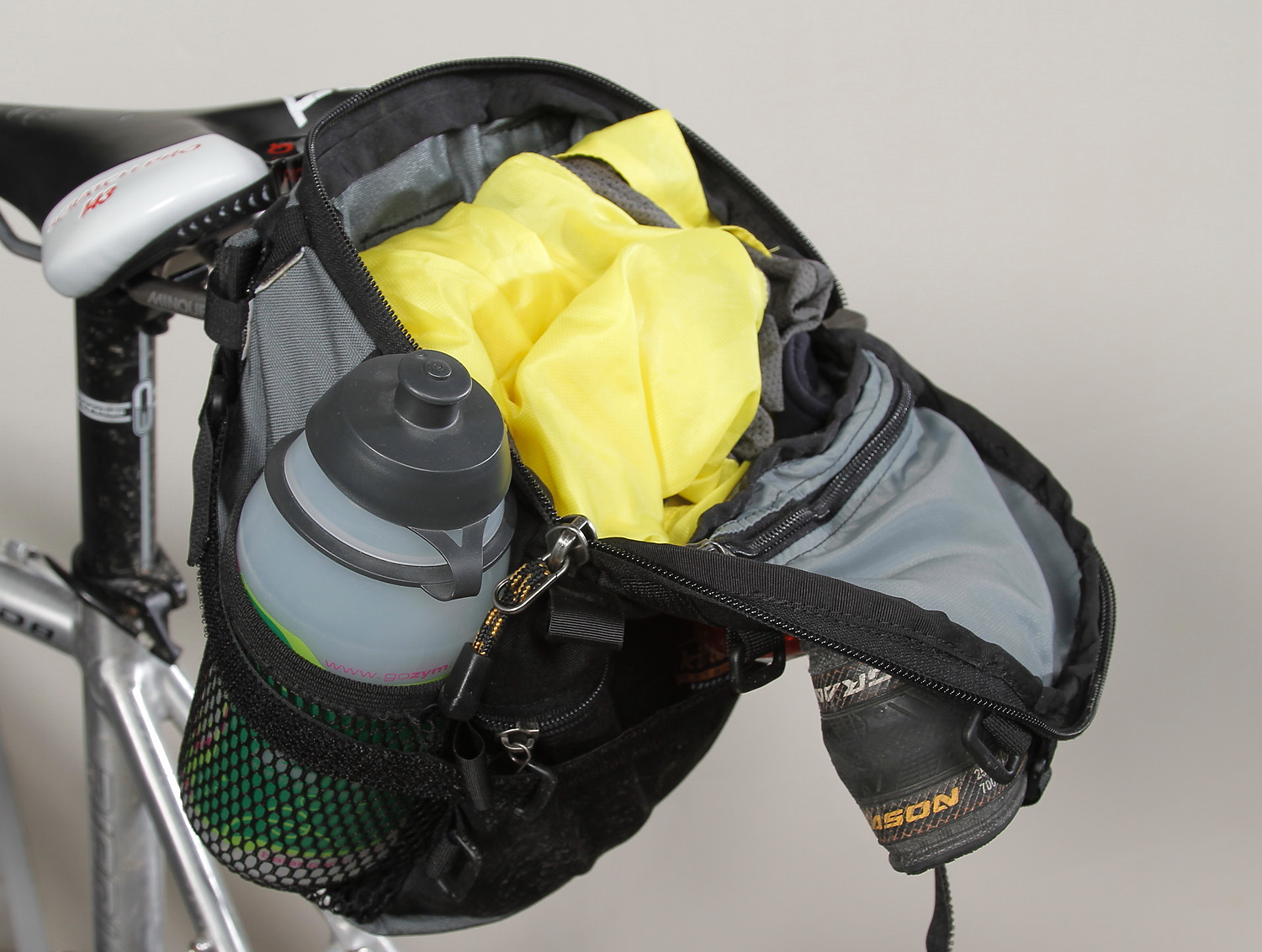
New Kinesis Saddlebags (soon to be called eoGEAR)

Close up of outer pocket (I just got back from a ride through a rain & hail storm, and the product is still dirty!).

The lid opens wide showing the hidden zippered pocket.
Backboard. Various size bags attach to this.

For the past three seasons I have been using Detours bags and like putting most of gear in a rear saddle bag. I also sell them on my gear site (Distance Biker). I don’t use a handle bar bags because I typically have clip-on aerobars mounted in the front. One of the things I have not liked about the Detours bags is the long mounting bracket — when I stand up to peddle or accelerate quickly, it tends to wag like a dog’s tail and throw me off balance. Correcting this imbalance also eats up extra energy too.

This winter I have been working on producing my own bag (or bag line) with similar volume to the Detours High Tail EXP UL as that has worked for me on longer brevets including 600s and 1200s. (My day job is designing and selling camera bags, Kinesis Photo Gear…the bike gear site is really my night job (this new line of bags will eventually be called eoGEAR (for endurance outdoor athletes). I didn’t like some of the bags that attached to the under side of a saddle to rails with straps only as they tended to sway back and forth, even with stabilizing straps that attach to the chain stays.

I started tinkering with the Minoura double water bottle bracket. After many prototypes (including mounting it up-side-down) it has proven to provide a very study mount for a bicycle bag system. It is made from a robust alloy with brass threaded inserts. The have recently upgraded the mounting bracket with heat treated steel to increase the strength of the mount. I have tested this bracket with a bag attached on both road (several 200k’s so far) and off-road situations (using my suspension-free, stiff alloy cross bike) — it is VERY stable.

If you have done any off-trail backpacking or mountaineering, you soon realize that the most efficient pack is one just large enough for your load, as a pack that is too large tends to sway under the motion of walking. Good internal backpacks also have several compression straps to keep the load close to your body and stabilize any externally added gear (like rope, crampons, jackets, water bottles etc.). These internal backpacks, while very functional, are not always pretty, as the compression straps tend to deform the shape of the bag…but it is functional, and that is what is important. The problem with many bike bags is that they put use stiffeners, plastics or wooden dowels to retain the shape of the bag. I believe in “form follows function” and tend to design with functionality and not prettiness in mind. I would rather shave off some weight and have a less-pretty bag if necessary.

This new bag line will have the following features:
1. Use of modern water-repellent fabrics like Cordura 500-denier cloth, instead of heavier and fungus-prone canvas duck.
2. Lean and mean approach. Build a bag that is barely large enough for the given task and then add additional gear to the outside of the bag when needed (instead of having a much-too-large of a bag which can be unwieldy).
3. Use of compression straps to stabilize the load and the ability to add gear to the outside as needed. I have designed this bag line so the same compression straps also function as tie down straps too.
4. Modular approach. I’m am using the same quick-attach method I use on my Kinesis modular belt-pouch line. It is called the Kinesis Attachment Tab System (KATS for short, also referred to as MATS, or modular attachment tab system). The backboard (alloy bracket + our additional HDPE piece) can stay attached to the bike saddle and various size bags can be swapped on our off.
5. Easy open “wide mouth” zippered lid. The zipper is water-repellent but not waterproof. We may offer a thin dry bag insert for those wanting more protection. The problem with a rain cover is that it will cover your tail light.”
6. Compatible with the Kinesis camera bag line…that is many Kinesis bags will mount directly to the bicycle back board.
7. US-made in small quantities.

Saddle Compatibility
Currently the bracket will attach to nearly any “plastic” saddle and the Giles Berthoud leather saddles, but will not attach to a Brooks or Selle An-Atomica (yet). The space between the rails is just too wide on those models.

Timing and Price
I will working on a final prototype this weekend and photographing it for an upcoming issue of the RUSA magazine. I expect to have final bags shipping in late May or early June…just in time for people to test them out before heading off to PBP. I have not determined a final price, but I suspect it will be around $95 to $130 for the bag and backboard. I will introduce smaller bags later on which will fit the same backboard — more of a “century ride” size.

If you interested in ordering one, please e-mail me and I’ll send you a link, once the product is posted on my gear site.

Weight and Volume Comparison (includes mounting hardware)
Detours High Tail EXP UL (my prior standard for 600s and 1200s) = 590 grams with 6 liters of inside volume
Carradice (Transverse model I believe) bag = 1210 grams with approx. 11 liters of volume
Ortlieb Large Seatpost bag = 330 g with 2.7 liters (claimed). No means to attach gear to the outside.
eoGEAR Prototype #4 Saddle Bag (shown in photos) = 450 g with 6 liters of inside volume. The size of this bag is 24 x 19 x 10 cm.

New Cross Bike

New Used Cannondale Cyclo-Cross Bike

I’ve been looking for a cyclo-cross bike for some time. I found a used one through the local online classifieds. It is a 2010 61cm Cannondale CAAD 8. A “cross” bike is essentially a road bike with more clearance for semi-fat tires. This model features an all aluminum frame with carbon forks and Shimano 105 20-speed components, excepting the cantilever brakes, which are Tektro. The unpainted aluminum makes it look like a titanium frame, so I have nicknamed this my “fake Ti bike.” The top tube is about the same length as my regular carbon road bike, so the fit is similar. The wheels are Cannondale’s in-house Maddux DRX 6000 model.

Upgrades…
I replaced the smaller 36 chainring with a smaller 34. The larger ring is a 46, which is typical for cross bikes (unlike the 50 on my carbon bike). I also replaced the stem with an adjustable model to get the bars higher. The head tube height on cross bikes are always short. I plan to use this bike as a trainer bike for local training rides, especially in the off season when the roads are wetter. The canti brakes don’t get as gunked up as regular road brakes. I use this bike for my daily run to the post office (except on most cold winter days — it is just too much work to get enough clothes on for the 4.4-mile round trip).

Here’s a quick review of the Topeak beam rack: The basket (Rack Top Basket) and rack (MTX Beam Rack) are from Topeak and remove quickly if needed. Before I purchased this combo, I suspected the basket might be a slight problem as there really isn’t enough clearance for my butt. I ended up taking a pair of ChannelLocks and bending the upper part of the basket back so it doesn’t rub while riding. I called Topeak customer service to see if there was an adjustment that I overlooked and they said no, but that the engineers/designers were aware of this clearance problem. If I wasn’t so tall, with the seat post extended up so far, the basket would never fit the average-Joe bike, as it has to go underneath the rear of the seat. The basket locks in place and will not stay on the rack, unless it is shoved all the way forward as shown. I then added some custom long straps to hold the packages in tight. The basket slips into place with their MTX QuickTrack system which is fast to use, but the basket to rack connection does have some wobble while riding. The rack itself does connect tightly to the seat post however and is a decent design. Occasionally, my inside leg touches or lightly rubs against the quick-release lever however. All-in-all, the rack is a good product, but the basket design needs an overhaul.

In the photo I have 28c semi-slick touring tires on it, but I also have a couple pair of 32 and 35c knobbies for off road use (they came with the purchase). For the pedals, I have used the Shimano A530, which has SPD on one side and platforms (for regular shoes) on the other. These are similar to the A520 pair I have on my road bike as they use SPD clips but are designed for road “touring” use. I have not purchased fenders, but plan to do so, thereby I can train on rainy days too. Or on rainy brevets I may use this bike.

I have found that riding an aluminum frame bike with wider 28c tires, although stiffer than a carbon bike, is about the same “discomfort level” as a carbon road bike with 25c tires. Instead of inflating to 100 to 105 lbs. as with my 25s, I only inflate these to 90 PSI. The longest ride I have take thus far is 2.5 hours or about 45 miles. As the weather warms, I will be doing longer training rides, and possibly do a 200k using the bike. Locally we have several rural dirt roads, that are not too steep. With this bike, it will increase my options for training rides. Or I may head to the west desert in Utah and attempt some long distance dirt road endurance rides. This last fall I helped pace a group of friends on a 100-mile relay race on the Pony Express Trail. I used my full-suspension mountain bike, but a cross bike would have been better for such a task.

Stay tuned as the season progresses. Safe riding to you all!

Cycling Jacket Review

Craft Bike Light Jacket

I recently set up a wholesale account with Craft, an apparel company out of Sweden. Aside from their nifty stretchy chamois’ (one, if not the only company with this unique design), I thought I would try their Performance Bike Light Jacket. Bicycling magazine had a decent review on this product a year or so back. This jacket is dubbed as a lightweight, wind protective jacket and not a “rain or insulative” piece of clothing. The Craft website said the product would have a nice tight fit, something I thought was possible only with much heavier “soft shell” jackets. Upon receiving the product I was just amazed at the ingenuity in this product.

1) The back of the sleeves and armpits are constructed with a stretchy mesh that gives the jacket a VERY tight, flap-free fit. When I first put this jacket on and felt the snug fit on the sleeves due to this design feature, I thought “those Swedes are just dang smart, this is a really well-designed jacket.” This also serves as an exit point for perspiration, something I dread on cool off-season rides. Unlike summer rides, I used to really smell after a mere two-hour winter workout as I had to wear enough wind proof layers to stay warm.
2) The fabric is super lightweight so the jackets wads up small to about the size of a baseball, and fits into one of the back pockets of my jersey. The problem with most jackets, is that people tend to leave them at home because they can take up so much space — yet if the one is doing an all-day ride, the weather or temperature can change later in the day or evening, especially on the downhills where wind chill can be a factor.
3) I’m 6-4 and wear 37″ long sleeves. Most jacket sleeves are way too short for me. Especially when I’m hunched over on a road bike. The sleeves on the XL model are adequate and yet the body of the jacket still fits me without a lot of extra play in the torso area.

Look for this product soon on my gear site, B&B Gear. List price $ 99.00.