Richard Stum’s randonneur cycling, rando skiing & SUP site. @rando_richard
Author: Rando Richard
I’m an old guy (age 69 in 2023) who enjoys aerobic, endurance sports. I call myself a cardio-junkie. Perhaps the more appropriate term would be “ultra” endurance sports. Since I was a teenager I have always enjoyed “slow twitch” outdoor sports like backpacking, ice climbing, running, mountaineering, hiking, alpine skiing and randonnée skiing (alpine touring, backcountry skiing or skimo). In 2005 I starting running with more regularity — except this time it was not for the intent of getting ready for a mountaineering trip, but as an end to itself. From 2005 to 2007 I managed to eek out two seasons of ultramarathons — that is competitive trail runs up to 50 or 100 miles. Due to a nagging ankle injury from the 80s (an accident while ice climbing in the 1980s where my lower tib and fib were badly broken), I had to cease that grueling, but rewarding activity. I then migrated into ultra distance road cycling or randonneuring. The rides are called brevets (pronounced bruh-VAY, it’s French) and are minimally supported — they are similar to ultrarunning and backpacking where one must be self reliant. Although brevets are non-competitive, they do have have cut off times to qualify as a finisher. They are usually are done in groups, which can have a competitive slant to them. Today, I continue to participate in long distance cycling including some ultra-racing, randonnée skiing (a blend of cross country and downhill disciplines) and still get out on an occasional mountaineering trip.
Since 1996 I have been designing, manufacturing and selling camera bags. That is Kinesis Photo Gear (kgear.com). In 2005 I started selling cycling bags under the Kinesis label and eventually expanded it to including other sports like SUP (stand-up paddle boarding and some skimo). Consequently, it become eoGEAR — the “eo” stands for endurance outdoor.
My wife and I are empty-nesters now and we live and work out in the boondocks of central Utah, half way between Salt Lake City (great powder) and Moab (great red rocks).
Well, I guess that is all for now. Safe travels mate! Perhaps I’ll see you on the road or trail.
— Richard Stum
A recently bicycle/vehicle fatality prompted me to write to the editor (the victim was a mentally disabled man on a 3-wheel trike riding in the dark, apparently on the wrong side of the road). Below is my text.
I was dismayed to see the fatal accident in the Oct 23rd issue. My heart goes out to his family and friends.
It appears that he was hit, perhaps due to to the fact that he was traveling on the wrong side of the road.
Because of this unfortunate accident, I wanted to remind readers of four points today (the first three are for cyclists):
Ride on the “right” side of the road. As an avid road cyclist (or “roadie” as we are called, which is different than those that primarily ride mountain bikes on dirt trails), I often see others in Sanpete County riding on the wrong side of the road. Just this past week, while riding toward Chester, I passed another cyclist, who was riding on the left side of the road into traffic. I yelled out “wrong side of the road.” His quick response was to point downward at the road, saying, “no, this is the correct side of the road!” Just as I was passing him, a car came in the opposite direction. Because of the foolishness of the other cyclist, the driver in the auto had to “shoot the gap” between the two of us, causing anxiety to all there that day.Utah State Law defines a bicycle as any wheeled vehicle propelled by human power with wheels not less than 14 inches in diameter (Title 41, Chapter 6a). A bicycle is considered a vehicle and is generally required to operate under the same laws as motor vehicles. The law states “A Bicycle must ride with the flow or direction of traffic (§ 1105).” Many people confuse this law with the rules for pedestrians, where the recommendation is to walk against traffic. These two simple rules are ones I learned as an 9-year old Cub Scout, yet many adults disregard them. These laws are common knowledge anywhere in the U.S.A.
Be as visible as possible. That is especially important during the shorter days of fall and winter. Wear bright clothing (I never wear a black or navy top). Have lights in the front and back, even during the day. Wear a reflective vest and ankle bands when at dawn, dusk or at night.
Be defensive & act as if you are invisible. Recently, while cycling through a busy intersection in front of Terrel’s grocery store in Mount Pleasant, a motorist quickly crossed the highway out in the front of my friend and I. He didn’t even see us and drove across both lanes of traffic to the other side. We both slowed down abruptly, barely avoiding an accident. As cyclists, behave as if you are invisible, as many motorists simply don’t look for anything other than other vehicles. You have to be a super-defensive “driver” while on a bike.
Share the Road. My last point is for motorists. Recently, many of the highways in Sanpete County received some new sets of road signs with the title “Share the Road.” The Utah State law states “Motorists may not pass within 3 feet of a moving bicycle (§ 706.5).” Please, please, do not cut cyclists too close. I worry about getting hit by the large mirrors of many trucks or school buses. Vehicles pulling wide trailers (ATV etc.) concern me. Drivers, please be aware of your total vehicle width and act accordingly!
Recently, there was a campaign going on by some of my cycling friends in Calif. (due to recent fatal accident there) to use the slogan “Change Lanes to Pass a Cyclist.” This is not state law, but is even better than the 3-foot rule. Generally speaking, most motorists in Sanpete County leave enough room and treat cyclists like a slow-moving farm implement, by swinging wide and/or slowing down. That is appreciated.
I have searched for some time now for an inexpensive training tire that had a high TPI count (threads per inch) with a dual compound. CST, a major OEM tire manufacturer (reportedly, one of the biggest in the world), introduced a foldable model called the Recourse C1808. The folding model is only available as a 700 x 25mm tire (ETRO 25-622), which is my preferred size anyway. It has a 120 TPI casing with their so-called EPS puncture protection. Most tires in this price range have a 30 or 60 thread count. Recently, while on a very rainy ride, I had a huge thorn (goathead) stick in this tire. I removed it and just kept on riding without a puncture! The listed weight is 205 grams. After installing onto my DT Swiss 1450 rims, it actually measured slightly larger volume than the Continental 4000 S 25mm tire. (Some other 25mm CST tires, like their popular Czar, measured in much smaller than the Recourse). Please note that this tire is also available with a single compound with a wire bead for much less.
August 2016 update: My daughter had a side-wall gash when using the above tire, after low mileage. Hmmm. Another option, in this same price range, is the CST Conquistare tire with a folding bead. It is only 60 TPI though which is great for commuting, but for those looking for a high thread-count performance tire, it may not cut it.
The list price on these CST tires is around $38, about half of a Continental 4000 S II, which is my “go to” tire for events. The CST tires are made in China and is available through my site eoGEAR as a special order item.
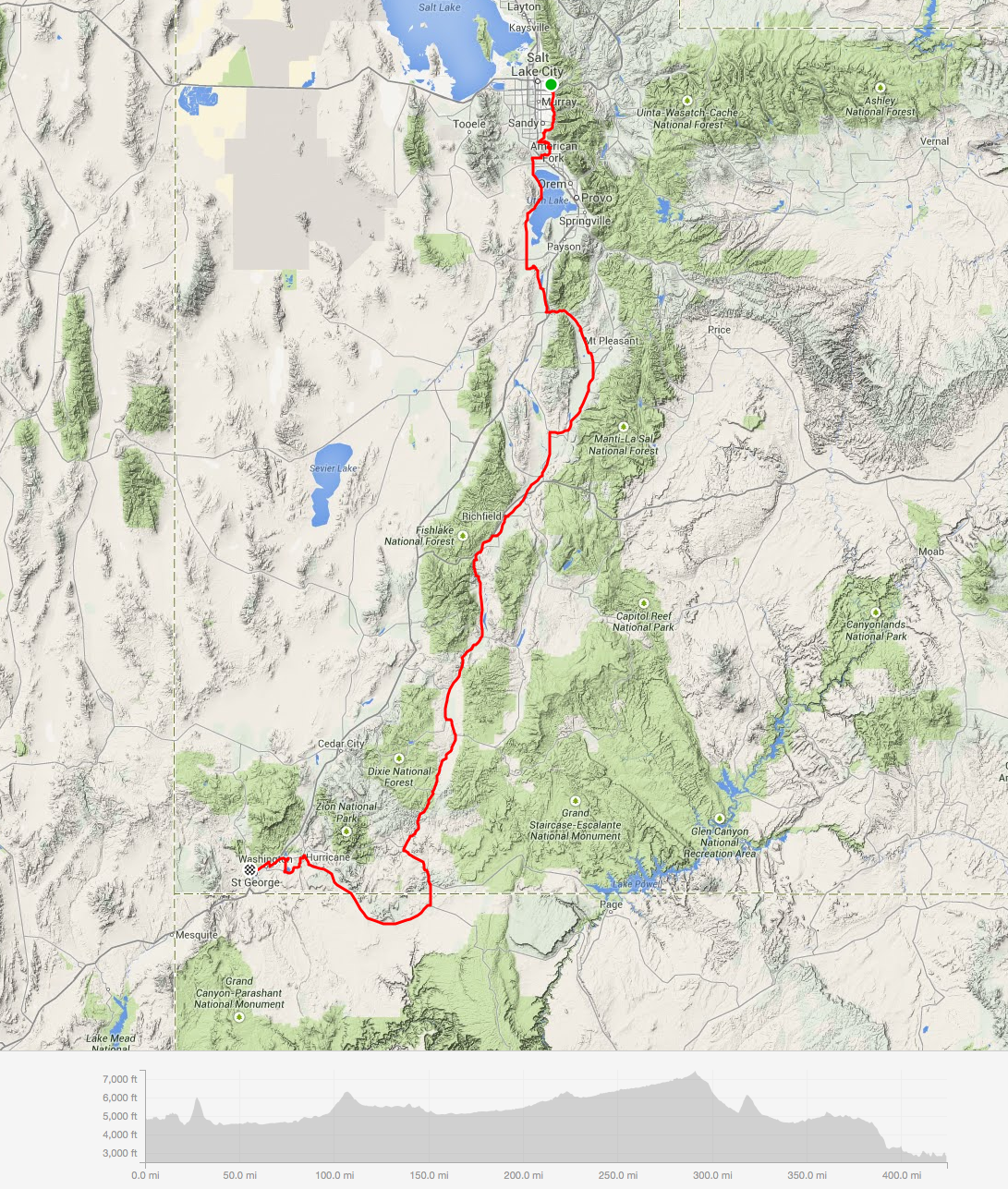
Route from SLC to Saint George. 425 miles & a moderate amount of climbing (approx. 15,000 ft.). My official time was 28:41.
In 2014 I got the idea to ride in a local 420-ish mile relay race, except NOT doing it relay style, but riding in the “solo” category. Salt to Saint is the name of these event which goes from Salt Lake City to Saint George Utah. Unlike many multi-day events outside Utah, this one did not conflict with Sunday, so I decided to give it a try, starting on Friday, September the 19th. Unlike some other relay races, this one allowed aerobars, something I use a lot on long road rides. Having done several longer brevets this summer, I knew what my average speed is for events lasting 400 to 600 km (250 to 375 miles) and I figured I could easily finish within the 34.5-hour cut off time.
I organized a crew, and, as mandated by the organizer, I needed two crew-support drivers for the night section, but only one during the day. My local cycling friend JB Harward consented to drive the first section from SLC to Sanpete County, where we live. For the balance of the ride I got help from two other local friends: Paul Hart (who introduced me to the ultra-endurance world of running) and Frits Tessers (an all-around guy that knows a little about lots of sports). I picked up my packet and these monster car stickers the previous night.
All the solo riders started at 8:00 a.m. JB was more nervous than I as he doesn’t know Salt Lake and managed to get lost, trying to follow the route. Early in the ride, there was a big climb up and over Traverse Ridge, so I started off with with my carbon-fiber bike, as it is lighter, due to no aerobars and a lighter-weight saddle. JB and I hooked up at Transition Zone two, some 33 miles into the course. At that point, I switched to my Seven Titanium bike which had aerobars and off I went to make the distance around the west side of Utah Lake. JB met a local friend there (Russell) there, who rode with him (in the car) for the rest of the trip to Sanpete County. I was not able to find other riders that were close to my speed when making my way around the lake, so I ended up soloing the whole thing. As I entered Juab County (near Nephi) I did find some help for perhaps 8 or 10 miles, and that was nice.
From there I climbed up Salt Creek Canyon to the slightly cooler temps of Sanpete County, where I live. JB & Russell met me at the transition zone in Fountain Green (mile 111), after which he left to switch crews. My next crew caught up with me near Manti at about mile 139. I rode all the way down US-89 and the we actually had a slight tail wind coming into Salina, which is atypical. It was nice going 22-25 MPH during much of that section. I also was able to draft off another relay rider before I flatted just outside Salina. I texted my crew who were nearby, and quickly come to my rescue, switching out wheels.
I was surprised how few people I was able to draft with. There were about 490 registered riders, but only 9 doing the solo version (7 finishers). The starts were staggered, based on your predicted finish time. When I did come upon another rider I would quickly mention to them I was a solo rider and they all let me “suck their wheel” as they were only going around 16 miles for each leg (unless they were doing double legs). But honestly, that only happened about 4 or 5 times for a few miles each.
As nightfall came, I added on my lighting gear and reflective clothing. This was just as I was entering Richfield at about 7:00 p.m. (mile 181). From there I continued to ride my Ti bike until we got into Hatch (mile 279), which is near the base of a long, slow climb up to a place called Long Valley Junction. There I switched bikes and stayed on my carbon bike the balance of the ride. One section of the roads was wet from rain, but it had happened just before I arrived. The high that day was in the mid 80s — perfect cycling temps. The nightime temperature at Hatch was a warm 48F, but it felt much colder to me due to my fatigued state. Consequently, I put on my winter soft shell jacket and neoprene booties, as well as some warmer mountaineering gloves (having a crew close by was wonderful!). There as a slight head wind for most of the night. Cycling down US-89 at night was great! No, really. Aside from the support crew cars & RVs, there were very few vehicles. Earlier this year I did another ride (a long brevet, which I organize), going down US-89 during the day, and we were weaving in out of the rumble strips as vehicles approached us. It was tedious. On Salt to Saint, my crew choose to shadowing me (driving slowing behind me with their flashers on), which kept me alert and moving. There were unbelievably helpful during this whole ride.
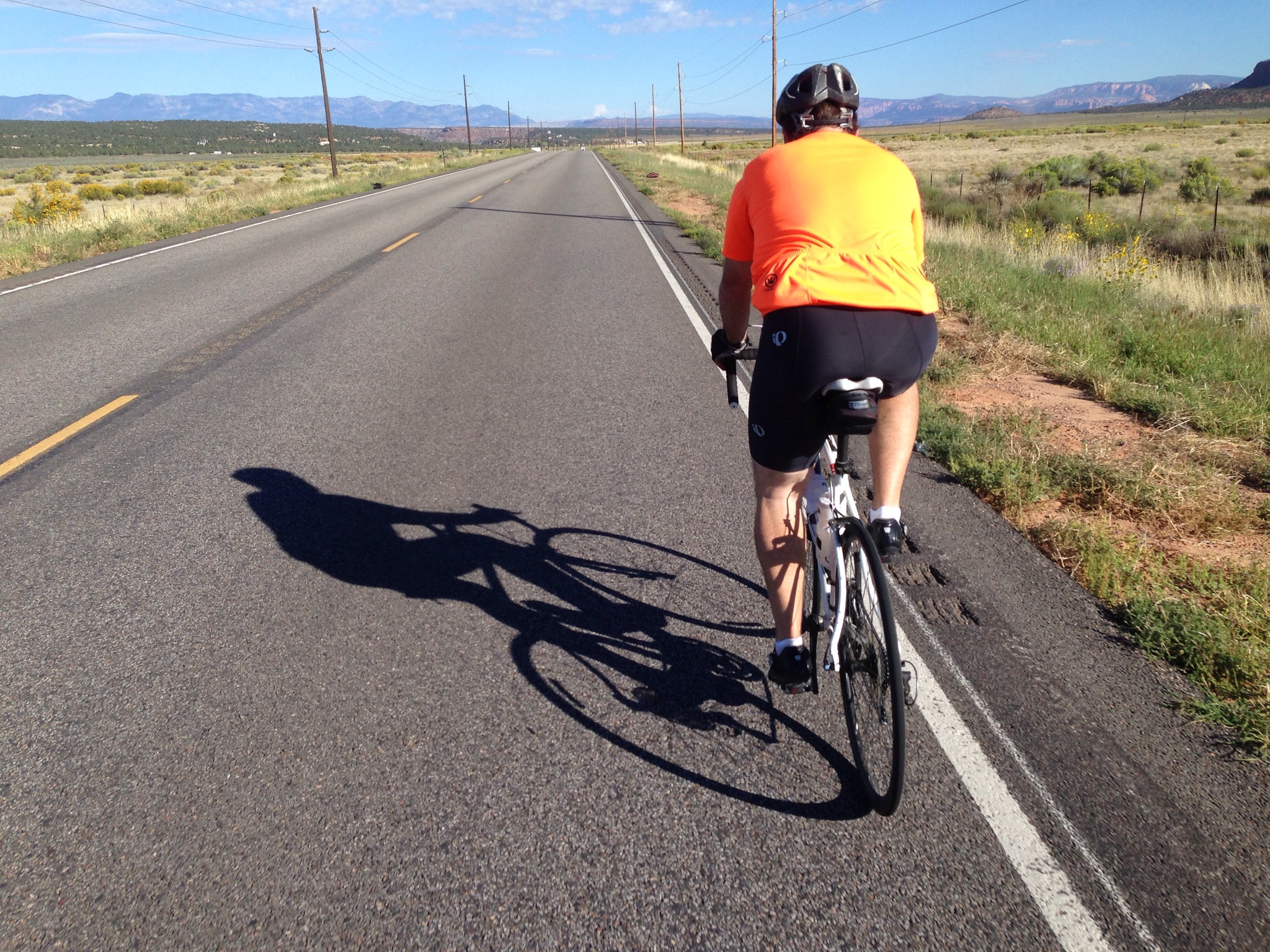
I finally arrived in Kanab at 6:00 a.m. (mile 332) and although my crew had a lot of food in the car, I wanted something hot, so we stopped into the local McD. The service was slow as there was also were a couple of 4-man crew trucks with riders going through the drive-thru. While waiting for my food, I rested my head down against the table and got a 5 or 10-minute power non-sleep “nap.” Dawn was just beginning to break as we left Kanab. I still had on all my warm clothing, finally removing it as the morning went. I quickly arrived into Fredonia Arizona, after which there is a long gradual climb to Colorado City. This section of the highway had a decent shoulder outside the rumble strips. But as soon as we entered Utah, the shoulder shrunk down to nothing (see photo). Here my crew shadowed me again, plus I got a free draft from another relay cyclist. We dropped into Hurricane Utah and it was now getting pretty warm. It was 10:30 a.m. I removed all my extra clothing. I realized that with my remaining mileage, I would not be able to achieve my goal of a sub-28 hour ride, but pushed on hard anyway. I went straight through for the next 31 miles (much of it had a bunch of short climbs) without any additional hydration from my crew, arriving at the finish at 1:41, yielding a final time of 28:41.
Overall, the neutral support was OK, but I only used it once their services once to top off my bottles and another time using their porta-potty somewhere along US-89 in the middle of the night. Most of the transition zones were about 18 miles apart — I usually stopped at every other one to top off my bottles or switch out clothing. Some of these areas has porta-potties and others had none (that I could see). At the finish line, their was fresh cut watermelon, pizza and sodas/or bottled water. Because this was a “race,” I took few photos so I could keep moving quickly.
Upon arriving at the finish, Clay, the organizer, indicated that to date (since 2010?), I’m the oldest cyclist to complete this ride in the solo division (age 60). Hurray — an unofficial course record!
Gear Tested: As a bag designer and owner of a niche-market online cycling store (eoGEAR), I’m always testing new gear.
– I had just picked up a new tail light, 1-watter, called the Radbot 1000, by Portland Design Works. I had it mounted to my seat stays. Additionally, I had a 1/2-watt Sigma Tail Blazer attached directly to my ankle. My drivers reported that this combination was “hands down” brighter than any other tail light combo they saw that night!
– Accelerade. I have used Hammer Perpeteum for many of my longer rides as it contains the “magical” mix of 4:1 carbs/protein (most sports drinks have no protein) — but I am not crazy about their flavor choices, so I decided to try Accelerade in tropical punch. That flavor was reasonably tasty…more so than the Cytomax tropical punch, so I most likely will c0ntinue using this product on future riders longer than three or four hours.
– Cocoanut Macaroons. Not everyone likes food with cocoanut. But I love it. And Bicycling Magazine suggested it. Everything we read is true…right? So I tried them and loved them. They are less messy than fig newtons and are less prone to drying out. I shoved four or five of them in the Fuel Container in my eoGEAR Top Tube Century Bag for easy access. Are they a good source of nutrition during an ultra-endurance event? Beats me. Sometimes, just any calorie is a good calorie.
Paul (left) and Frits — the night dream team! Stayed awake all night. Note our “unlucky” 13 rider number.
Clay Christensen, the organizer, at the finish.
JB & I in Fountain Green.
Stretch west of Colorado City — zero shoulder with 65 MPH traffic!
Climbing Repeats (no surprise)
Summary: Two to three sets of 8 to 12 minutes each at a continuous, tough rate at about 85-95% of your max heart rate. Each set should have a cool down or rest period of about half of the duration.
Over/Under Intervals
Summary: On a gradual hill, ramp up your heart up near your max for two minutes and then take it back to the your threshold for another two minutes. Repeat several times for 10–12 minutes for each set. Do three sets with rest in between.
Threshold Ladders
Summary: After a warm up, do a climb at a 90-100% of your maximum heart rate for two minutes. Then step it down for four minutes (approx. 85-90% max.), then step it down again for four minutes (75-85%?) and then finally at a sustainable climbing rate for six minutes. Rest for four minutes and repeat.
Moose visitor center on day 1 at the bottom of Cameron Pass
End of the first day…just at dusk.
Snowy Range (WY) just before a big hail storm at the top.
Day 1, back side of Snow Range..riders warming up.
Kerin bunbled up for wet weather.
My wet weather apparel.
Food spread in Steamboat Springs.
More goodies.
And more.
Muddy bike after two days of rain.
Dawn on day 2 going through Yampa
Day two climbing (Kerin)
At another pass on day two.
Various bike types
Descending
Willow Creek Pass on day 3
Tammie doing her food majic.
Problems with custom soles required some field adapation.
Day 4 at the Moose visitor center again (Peter).
Peter warming his hands.
Last checkpoint of the ride!
John’s heavy load.
Me at the finish.
Jim Halay, also from Utah, receiving his medal from Foon.
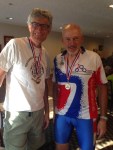
Jim and I.
This year my annual 1200 km grand randonnée was in Colorado from July 15-18th. It is called the Colorado High Country 1200. Here is the Ride with GPS online map and my Strava upl0ad, made after the ride. (750 miles with approx. 33,000 feet of climbing over 3-1/2 days).
As always, this will be a Twitter-like report. To see a photo larger, click through twice to make “it” happen.
I decided to “use up” one old tire and put it on the back rim, which had kept me flat-free for the past several thousand miles that spring. But as seems to be tradition with this ride, I got two back-to-back flats about 70 miles in on day one. I was carrying a spare tire and swapped it out, later disposing of that tire. Because of this flat, I fell behind many of the riders I would have like to hang with. This year, the climb up Cameron Pass was dreadful, due to tons of biting black flies. Kinda like horse flies, but smaller. Dozens of them all over my legs and arms, but oddly not my face! I thought that as I climbed up to cooler temps, they would dissipate, but they didn’t.
The first two days we had unseasonably cold weather with blowing hail, rain, thunder and lightening. Crossing over into Wyoming, we had a nasty crosswind, which later produced pea-sized hail. Earlier, I left the Walden, a supported checkpoint, with Luke Heller. We alternated working in the wind, as best as possible in cross winds. His stomach started bothering him, so at the last town before the overnight, a few of his friends caught up to him and I kept on moving on, arriving at about 9 p.m. to the motel, just as it was starting to get dark. The mileage that day was about 219 miles.
After a good breakfast, day two started at 3:30 a.m. with a monster climb (3,500 ft?) up to Snowy Range. At about 4:30 I started to pass many others, which had left in a big at 3:00. Eventually I came upon, Kerin Huber, a tough rider from Calif. She and I rode together the rest of the day. Near the summit of this climb, her speed dropped off and I continued on to get caught in a heavy hail/rain storm right at the treeless summit (a cold 38F). It hit when she was near a forest service restroom and ducked in there for protection from the elements. I quickly put on my helmet rain cover and climbed through it all. I already had on my Craft waterproof/breathable jacket. I was shivering so much on the descent, that my front wheel was wobbling a ton. Others reported having the same problem. I later stopped on the descent, down in the protection of trees and put on Rainlegs. I finally made to Centennial and stopped in a c-store to warm up and feed. From there we continued to Laramie and eventually over Rabbit Ears Pass (with thunder and lightening) and down to Steamboat Springs. Throughout the day, the weather alternated from warm and sunny to rainy and cold. Kerin and were constantly changing layers to keep up with the ever changing conditions. I arrived well before sunset and was able to get some much needed rest and food. The mileage that day was 199 miles.
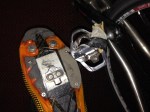
Day three started at about 4:15 a.m. Kerin had left earlier as I was slow getting going that day. The forecast was much better. I passed a few groups as dawn was breaking and came upon Kerin again. We rode the first half together, working together on the flats drafting and sometimes side-by-side talking. Later that day, my knee started hurting, which was a totally new problem for me, I had her ride on ahead of me, while I tried to fix my problem. I usually have saddle sores, but rarely other issues. I thought it must be the height or angle of my saddle and started to fiddle with it several times to little avail. So just ingested more “vitamin I” to mask the pain. Part of my elevated sole (to compensate for leg length inequality) of my sole fell off, so I jury-rigged up some wood on my pedal to compensate for this. Mileage on day three was 193.
Day four started kinda late as I really wanted to catch up on some sleep (I started day one sleep deprived, having stayed up late visiting family in the Denver area), so I left at about 5:00 a.m. with my motel-mate, Peter Hoeltzembein, who is from Canada. It was about 37-40F and his hands were freezing as he had only brought short-fingered gloves. We stopped about an 90 minutes into the day at the Moose visitor center (still closed) and his fingers started to warm up a little, but my knee was still bothering me, so I let him proceed alone. On the climb up to Cameron Pass, I discovered the problem. Before this ride, I very firmly (with an allen wrench) set the angle of float on my cleat at a normal 90-degrees. But my heel “wants” to turn in (due to an old climbing injury and subsequent surgery), which frequently rubs against my crank arm. The cleat finally loosened up (inadvertently) enough so my heel could turn inward and my knee pain quickly diminished. But the damage was done, so the rest of the day I had a low-level pain in my pain. At the last checkpoint of the day, I met John Pearch (from Washington state) and we rode most of the balance together. Mileage for the day was “only” 147.
Many thanks to John Lee Ellis, his wife, and others that helped out to make this event possible. As always, it was nice to have a hot supper waiting upon arriving at each overnight and then have a solid breakfast for the next day.
This brand is the worst. A14 foot bag should be 14 feet long. It’s about 4 inches short. Two years ago I bought another of their bags and it was about 6 inches short so I exchanged it for this one which is still short and barely fits the board. without cramming it into the bag.
Ruby’s Inn General store, on the outskirts of Bryce
Bryce Point
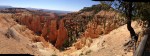
More Hoodoos
Heading south along US-89
Restaurant afterwards
For several years, I have tinkered with the idea of doing a Grand Randonnée in the national parks of southern Utah. A Grand Randonnée has the minimum distance of 1200 km (750 miles), over a 90-hour time period (just over 3-1/2 days). During the fall and winter of 2013, I begin working on some routes. I wanted the riders to be able to visit one national park (or monument) each day — hopefully daylight hours too. I mapped out literally dozens of routes on Ride with GPS, and finally settled on this one. During the early part of 2014 I got it approved as a RUSA “permanent” which means can be ridden any time and not on a scheduled day. It is called the Red Rocks Randonnée 1200.
My intent was during the 2014 season, to ride two 1200Ks (celebrating the fact that I just turned 60). I was hoping to ride this one during the spring of 2014, but couldn’t find enough others to join me. During this time, Jim Halay, a resident of Eden Utah and a member of Salt Lake Randonneurs, a group I manage, needed a 600K ride to qualify for a 1200K coming up. So I decided to quickly design a 600 km shortened version of this route and then just do it. We were joined by none other than Debra Banks, a very active randonneur (or randonneuse to be exact) from Sacramento. She is also the designer/owner of Rivet Cycle Works, which makes some killer suspended leather saddles. (Read her blog report of this ride here.)
Finally, on June the 3rd (2014), at 4 a.m. we started off, leaving our motel in Kanab Utah (elevation 4,953 ft, very near the southern border of the state). This was a self-supported ride. The local temperature was in the upper 60s, so most of us wore minimal clothing as we heading south towards the Arizona border. After less than eight miles we were in Arizona and the temperature was dropping to the upper 40s. Rather than stop and add layers, we just kept riding, toughing it out. After 50 cold miles, we came to our first checkpoint in Apple Valley, a Chevron c-store. We immediately stepped inside to the warmth of the building and consumed some breakfast foods. The sun was just rising over the bluffs to the east.
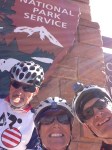
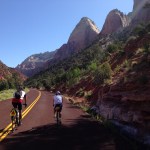
Staying together as a small group, we proceeded on our way, dropping in elevation to the low point of the ride, which was in Hurricane Utah, elevation 3,248 ft. The forecasted high was in the upper 80s or low 90s, but it was still early morning so we were not feeling the heat of the day yet. We climbed out of Hurricane up to Springdale and through the entrance to Zion National Park. Our route continued along the valley floor, with spectacular views of the red canyon walls, some 3,000 feet tall. Our route ended at the end of the road, which is called the Temple of Sinawava. This location is also the exit point for those walking up the Virgin River doing the legendary Zion Narrows. We topped off our water bottles and reversed our route, dropping in elevation as we followed the Virgin River downstream along Highway 9.
We then started climbing in earnest as we got on and off I-15, heading north to Cedar City. At one point, Deb and I stopped under a freeway overpass to cool down as we waited for Jim. He arrived and kept on riding past us. After finishing our conversation (mostly trade talk stuff) and topping off our internal radiators, we continued the climb, hoping to catch Jim. As it turns out, he pulled off in Cedar City to rehydrate and the two us, having stopped earlier, unknowingly went past him. The three of us later regrouped at another c-store at the north end of Cedar City. From there we continued north and finally got off the interstate for the last time and onto SR-20 for the final climb of the day. This climb was approx. 1,700 vertical. The grade was not steep, but continuous. Deb and I grabbed a third bottle of water at the last checkpoint and carried them along with us for this anticipated climb in the late afternoon heat. The climb topped off at 7,863 feet, just as the sun was beginning to drop near the horizon. That was at mile 208 for the day. We made a quick descent down to US-89 and then eight flat miles into our overnight destination in Panguitch at mile 229.
Jim and I drove through Panguitch the prior day, on our way to Kanab. While doing this, we left off some drop bags with our overnight supplies at our designated motel at the Owen’s Travel Center (truck stop). I choose this location for the overnight stop because it is the only spot in the area a with 24/7 c-store. Deb, on the other hand, overnighted a FedEx box of supplies for herself to this location. We arrived at around 8:30 p.m. We knew that the pizza place next to the motel closed at 9:00 p.m., so we went directly there, instead of checking into our motel. After a much-needed supper, we checked into our motel and decided to resume our ride at six the following morning. The elevation at Panguitch is rather high at 6,600 ft.
The three of us ate breakfast (from our drop bags mostly) and heading out into the chilly air. It was 29F, but we bundled up well, unlike the previous day. This part of the route takes in a few rollers, before making a 1,100-foot climb to the east, up a nicely paved bike trail. From there it heads south, climbing again, towards Bryce Canyon National Park. Before the entrance we stopped at Ruby’s Inn General Store. Compared to the Panguitch truck stop/c-store, this was a super-market, with many choices of groceries and food. Most of grabbed some sort of frozen “delight” and microwaved it and then we sat on the south-facing benches of this store, enjoying the warming rays of the morning sun.
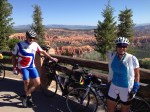
From Ruby’s Inn, we made our way into the park and visited several lookouts, some of which were on the cue sheet and some that were not, doing some recon for future brevets. Unlike Zion, in Bryce you are looking down into the canyons and riding along the top of a ridge inside this beautiful park. The early morning light provided great views of the many hoodoos in this park (sandstone spires). Finally, after exiting the park we proceeded back down to highway 89 and headed south towards Kanab, generally loosing elevation, but into the typical prevailing SW wind.
We later stopped in the small town of Hatch, finding a decent c-store (news to me…will be noted on future cue sheets) and then kept on going towards Mt Carmel Junction, which is near the eastern entrance to Zion. After grabbing supper at the local Subway (mile 337), we made another climb up to the junction to Coral Pink Sand Dunes and headed south to this state park, leaving busy highway 89. My shoes, which were some two months old, were giving me issues and I had developed a nice blister or callous spot on my right pinky. These shoes were a tad too narrow and so I had them loosely buckled, causing my foot to slide forward, making matters worse. I finally took an unneeded arm warmer and stuffed it under the buckle, as I had the buckle tightened all the way, but the shoe was still too loose. This helped a lot, but the damage was done. After more climbing and a short descent, we arrived at the state park. There was water and restrooms there which we needed as we were now in the later afternoon heat of southern Utah.
Soon, we realized that we had only approx. two hours to finish this ride and had 20 miles to go. This permanent must be finished in 40 hours or it is considered a DNF. We left briskly and made a u-turn, and after a short climb, we were rewarded by a quick descent on a rather rough, patched and potholed paved road (Hancock Road) back down to US-89. I am glad it was daylight, as I would not want to be descending this crappy road in the dark! But at least there no traffic along this section of road. We then had some easy gradual downhill miles back to our motel in Kanab, arriving with only 45 minutes to spare. Our generous sleep stop and side trips in Bryce Canyon really cost us time and nearly cost us the whole ride!
My GPS/Strava download indicated a little over 17,000 feet of climbing. A few seasons ago, I did the Grand Canyon 600, which had approx. 20,000 feet of climbing and also had similar wild temperature variations (from 33F to 95F). This one rates up there as “one of my toughest 600s.” When designing the route, I actually tried and tried to reduce the climbing, but simply couldn’t do it without cutting out one of the parks and diluted the very essence of this route. Afterwards, we stopped by a local BBQ restaurant to top off our tanks once again. Deb spent the night in Kanab and Jim and I made the drive home, stopping a few times for truck-stop cat naps.
Meanwhile, it will be impossible for my tiny RUSA region to support a full-blown 1200K, unless it is essentially a self-supported event, which means no meals at the overnight stops. This could be a problem as neither of the two key central cities on this route (Panguitch and Kanab) have any 24-hour restaurants, only 24-hour c-stores. The 1200K Red Rocks route has about 30,000 feet of climbing. This is not be the toughest 1200 out there, but it certainly rates high. Consequently, I am rethinking the whole thing. I have now designed a new 1000K route and may try to do this in the fall of 2014 as a permanent. I’m seriously considering adding three ACP “Red Rock” choices for the 2015 season — a 400, 600 & 1000, all starting at the same time and date and roughly following the same route.
Last year I took and built up a Seven titanium bike and used it on a 1200K grand randonnée. I just about died because of butt soreness in the last two days of this four day event (see this post).
Consequently, I have purchased this new so-called suspension seatpost from Specialized (it’s nickname is the cobbler gobbler). It has made an incredible difference. Even on a short 50 mile ride where I’m in the aero bars a lot I can feel the difference in the buzz of the road. It has kept me from selling or retiring this double-butted titanium frame.
I highly recommend it for those that are suffering with saddlesore issues or other butt comfort problems.
The single mounting screw is very fast to adjust as one screw adjusts fore/aft distance and the angle (the easiest to install and adjust of any of the saddle posts I have used). But the only caveat with this post is that because the adjustment screw is on the side of the post, some suspended leather saddles may not work as the side apron of the saddle covers up the adjustment/mounting screw. My Gilles Berthoud touring saddle (Aravis) has been trimmed back a little so I am barely able to access the allen screw. My guess is that the Brooks Team Pro or B-17 would prevent access.
This summer (2014), it served me well and was comfortable on CHC1200 with the same saddle and wheelset as my difficult 2013 1200K.
I do not sell these on my website. This item is only available in 27.2 mm diameter post.
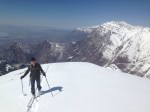
In March, four us (Jim Knight [+ his hound dog], Mat Gover, Joey Dempster & myself) did a hike/ski ascent of Provo Peak, just east of Provo (11,044 ft). I attempted this peak some 10 years ago, but due to inadequate equipment, I could not summit. On that attempt, also with Jim Knight, I didn’t have boot or ski crampons. The summit ridge was very windblown with a firm crust. My boots gave me no purchase. Jim went to the summit without me.
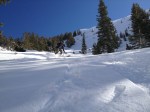
This year was different. I brought both boot and ski crampons (neither of which I used). We had 6 to 8 inches of fresh snow the prior night. We started up Rock Canyon on foot and proceeded to carry our skis for a few miles before there was enough snow to ski. Later we approached the peak from a N.W. ridge, which at times was difficult for me in the new powder, as my old Scarpa Laser boots didn’t provide the flex necessary in parts and I slipped backwards at times. We finally gained the main west ridge and uphill travel was easier. The descent down was very nice, with new snow over a firm base.
Day 3 of 2008 Last Chance (my first completion of a 1200K or 750 mile brevet). 12 hours of constant rain and 45-50F temps. (Click or double-click for larger image)
Brief overview of gear used for rainy rides + other gear notes. Nearly all of these items are gear which I have tested first, and then posted on my online gear site: eoGEAR.
Shower cap on helmet. I now use a commercial one and cut a slit for my headlamp.
Goretex style jacket (i.e waterproof breathable). Look for something that is factory seam sealed. A wind jacket is not enough for constant, cold rain. (2010 update: I now use and really like the ultra compact bright-colored fluorescent lime-green Craft Performance Rain Jacket. It is amazing as it breathes quite well for one providing such remarkable rain protection).
Neoprene gloves. Designed for scuba diving and 3mm thick. Perfect for terribly days like this.
Rainlegs. Keeps rain over your lower body. Super lightweight and worth their weight in gold. Keeps you warmer too.
Grocery sacks on my shoes to keep rain out. Despite using Merino wool socks, I still got cold feet. I now pack neoprene cycling toe warmers if the weather looks bad or a pair of Craft rain booties that cover my entire shoe. For one recent long rainy ride (2013 Gold Rush 1200K), I did use thin neoprene socks (instead of over booties or toe warmers) and while they kept my feet warm, they seemed spongy and I felt I was loosing power to the pedals.
Aerobars. I think I’ll write an entire article why I like them, especially the Syntace C2 or C3 Clip Ons. Super thin and lighter than most carbon fiber models.
Vinyl cue sheet holder. Custom made and attached to the aerobars (can’t see in photo). A godsend for memory deprived people like me.
Top tube bag (just behind the bars). This enables me to eat on the fly. With layers of clothing including a reflective vest, it is hard to get out of your rear jersey pockets. Oh, that is my design, the eoGEAR Top Tube Brevet Bag.
Pump. A mini-floor pump with a hose. No hose, no pressure. You can place the base of this on the ground and apply body weight. This is simply no way to get 120 PSI from one without a hose. I use the Topeak Mini Morph with Gauge. Lezyne makes some good models too.
Saddle. Unpadded suspension leather style. Selle An-Atomica. I DNFed on my first 1200 attempt because of saddle sore issues.
Rear seat post bag. Big enough for extra clothes, after the weather turns warm. Detours High Tail EXP UL was my favorite for 400K + rides. I now make my line of bags called the eoGEAR RandoBags.
Tires. Maxxis Refuse 25s (700 x 25c). Softer ride than 23s. Besides, I’m 6-4 and with that height I pack more weight than the average 5-10 rider. I inflate the front to 110 PSI and the rear to 110 or perhaps 115 max. (2012 update: Continental Grand Prix 4000 S or the 4-Season are my new preferred tires).
Gearing. Compact double chainring (front). I use a special French-made 33 ring in the front (instead of the stock 34) for more climbing power when tired. Combine that with a 10-speed 12-27 cassette (shown) and you are in pretty good shape. I plan to upgrade to a 11-28 or 12-28 when that one wears out. That new combination will give me the equivalent of a triple in front and a 12-25 in the back. (2012 update: Shimano 12/30 cassette,10 speed is now in use.)
Oh the bike! Yeah, a stock frame with pretty traditional racing geometry. Low end model with a blend of carbon fiber and aluminum (joints). 61cm. Head tube too short for me. Still shopping for something better. 20 or 21 lbs. without extras. Fezzari CR2. Manufacture direct pricing. (Since then I have purchased a Rocky Mountain carbon and a second-hand Seven Ti road bikes).
What have I missed? Shoes and pedals? I used stock racing-type pedals and shoes that season, but I have switched to something better for rando rides. More to come later on that. When I get time—if I get time!
























 Rando Richard Blog