My first long ride on a road bike was a typical 100-mile charity “century” ride. That is where I first come to realize that neck pain was commonplace for many roadies. Since then, I have ridden thousands of miles, mostly using bicycles with aerobars. I use the aerobars for two reasons (#1 is the most important): 1) As a 6′ 4″ tall person, aerodynamics on a road bike has always been an issue, so I adopted the use of these to limit my wind resistance. 2) Changing out of hand positions. Using aerobars enables me to move around more on the bike to limit the pain in my hands and lessen the fatigue in the upper body.
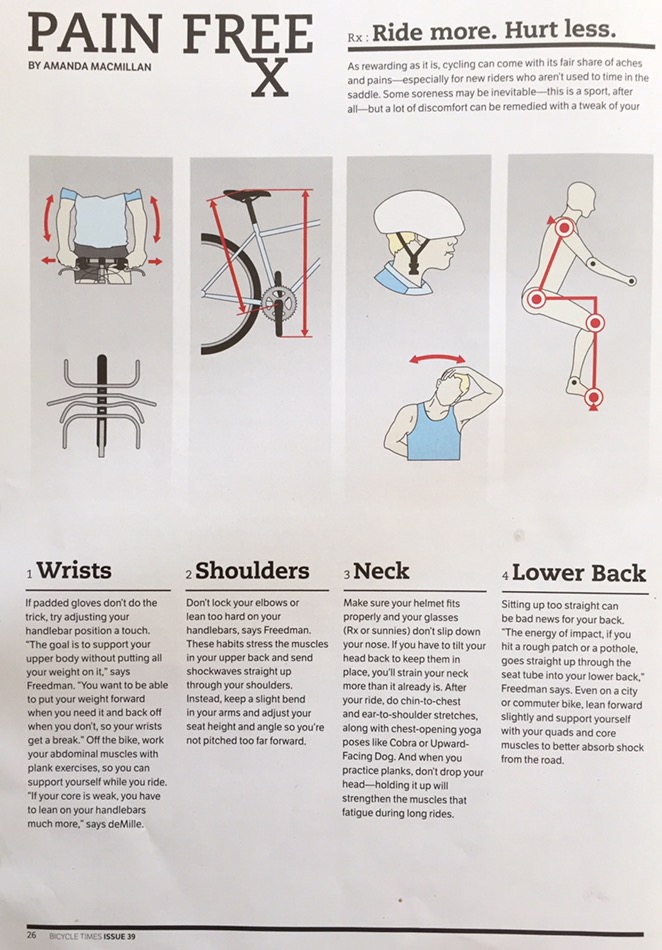
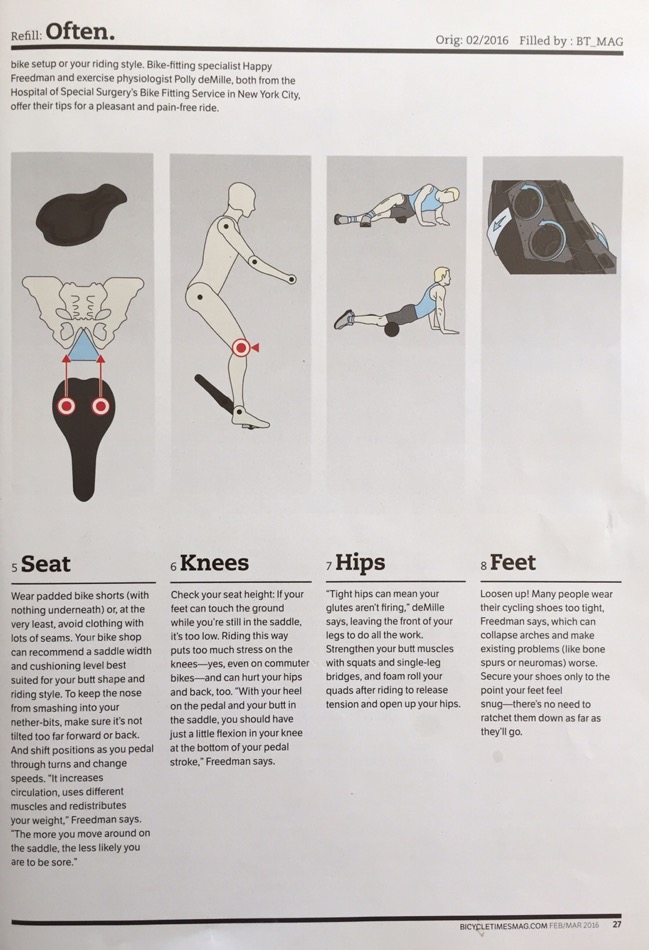
Recently I saw this article in the March 2016 issues of Bicycle Times magazine and have reposted it here (used by permission). Points two through four are relevant to neck pain.


I have consulted with my nephew, Jeremiah DeLlamas, who is a seasoned physical therapist. Below are his suggestions on how to alleviate soreness when riding.
When I ride, I really try to consciously remind myself to perform chin tucks and shoulder retraction exercises or Shoulder pinches. Because of the rounded shoulders and forward head in the extended position, this puts a lot of stress on the posterior disc of the cervical spine and deep cervical musculature. Try to deep the chin tuck exercises and this will help activate the deep cervical muscles as you are riding. Every 20-30 minutes remind yourself to do 10-15 chin tucks holding for 5 seconds. Stop in at the building when you are in town and we can go over more.
My takeaway from his suggestions was to regularly tilt my head down (aka chin tucks) while riding. I used to only turn side to side, which providing marginal, if any, benefit.
Hopefully, these suggestions will allow you to go further and/or faster, while minimizing your pain threshold!

Author: Rando Richard
I’m an old guy (age 69 in 2023) who enjoys aerobic, endurance sports. I call myself a cardio-junkie. Perhaps the more appropriate term would be “ultra” endurance sports. Since I was a teenager I have always enjoyed “slow twitch” outdoor sports like backpacking, ice climbing, running, mountaineering, hiking, alpine skiing and randonnée skiing (alpine touring, backcountry skiing or skimo). In 2005 I starting running with more regularity — except this time it was not for the intent of getting ready for a mountaineering trip, but as an end to itself. From 2005 to 2007 I managed to eek out two seasons of ultramarathons — that is competitive trail runs up to 50 or 100 miles. Due to a nagging ankle injury from the 80s (an accident while ice climbing in the 1980s where my lower tib and fib were badly broken), I had to cease that grueling, but rewarding activity. I then migrated into ultra distance road cycling or randonneuring. The rides are called brevets (pronounced bruh-VAY, it’s French) and are minimally supported — they are similar to ultrarunning and backpacking where one must be self reliant. Although brevets are non-competitive, they do have have cut off times to qualify as a finisher. They are usually are done in groups, which can have a competitive slant to them. Today, I continue to participate in long distance cycling including some ultra-racing, randonnée skiing (a blend of cross country and downhill disciplines) and still get out on an occasional mountaineering trip.
Since 1996 I have been designing, manufacturing and selling camera bags. That is Kinesis Photo Gear (kgear.com). In 2005 I started selling cycling bags under the Kinesis label and eventually expanded it to including other sports like SUP (stand-up paddle boarding and some skimo). Consequently, it become eoGEAR — the “eo” stands for endurance outdoor.
My wife and I are empty-nesters now and we live and work out in the boondocks of central Utah, half way between Salt Lake City (great powder) and Moab (great red rocks).
Well, I guess that is all for now. Safe travels mate! Perhaps I’ll see you on the road or trail.
— Richard Stum
View all posts by Rando Richard
 Rando Richard Blog