Richard Stum’s randonneur cycling, rando skiing & SUP site. @rando_richard
6 Ways To Determine Your Maximum Heart Rate
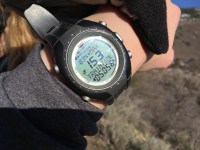
Most GPS units or heart rate monitor watches ask for your maximum heart rate so it can calculate the different heart rate zones. I have outlined several different methods below. Please note that your maximum heart rate is different than lactate threshold. As per this article in Road Bike Ride, by John Hughes, “Max heart rate doesn’t show cycling fitness,” but instead “lactate threshold is a better measure of fitness.” I have covered that topic on this blog post.
Here are some formulas for determining your maximum heart rate:
The old classic easy-to-use formula is 220 minus your age for males or 226 for females. But is a very rough estimate and can vary widely.
Here is another formula, perhaps more accurate than the above: “The maximum heart rate of male athletes was calculated to be 202 – (0.55 x age), and for female athletes, 216 – (1.09 x age).” From the RBR site and is Dr. Mirkin’s formula from a study in Liverpool England.
I believe this is most accurate technique, by Edmund R. Burke, PhD, as found on pg. 74 in the timeless book Serious Cycling (2nd Ed).
Do an all-out effort on a 5 km (3 mile) time trial (solo and a generally a flat course). Determine your average heart rate in the middle of this ride. He says. This is your exercising heart rate. Manually plot your heart rate against your time and speed on a graph. You’ll see that your heart rate levels off in the midportion of the ride. This corresponding heart rate is your average heart rate. Multiply that number by 105 percent to arrive at your maximum heart rate.”
Sally Edwards, in her book The Heart Rate Monitor Book, suggests…
finding a long hill or series of hills and, after warming up, hitting the bottom of the hill relatively fast. Work the hill extermely hard until your heart rate reading no longer rises and you approach exhaustion. This number is your maximum heart rate. (Quoted in the book Serious Cycling above.)
It would seem to me that if you race (as opposed to just training or causal “riding” with friends), that taking your highest recorded heart rate during an event would yield the same result as Sally’s method above.
Have a medical professional conduct a stress test and let them know you want to know your absolute maximum heart rate. This is usually done on a treadmill, however, and not on a bicycle, which may yield a slightly higher value.
Sigma of Germany makes some nice heart rate monitor watches and cycling computers. Here is their formula, from their PC15 instruction manual (circa 2007).
First, convert your weight from pounds to kg: divide by 2.2. Then for men: 210 – “half age” – (0.11 x weight in kg) + 4 Or for women: 210 – “half age” – (0.11 x weight in kg)
Also visit this page on my blog about anaerobic or lactate threshold.
I’m an old guy (age 69 in 2023) who enjoys aerobic, endurance sports. I call myself a cardio-junkie. Perhaps the more appropriate term would be “ultra” endurance sports. Since I was a teenager I have always enjoyed “slow twitch” outdoor sports like backpacking, ice climbing, running, mountaineering, hiking, alpine skiing and randonnée skiing (alpine touring, backcountry skiing or skimo). In 2005 I starting running with more regularity — except this time it was not for the intent of getting ready for a mountaineering trip, but as an end to itself. From 2005 to 2007 I managed to eek out two seasons of ultramarathons — that is competitive trail runs up to 50 or 100 miles. Due to a nagging ankle injury from the 80s (an accident while ice climbing in the 1980s where my lower tib and fib were badly broken), I had to cease that grueling, but rewarding activity. I then migrated into ultra distance road cycling or randonneuring. The rides are called brevets (pronounced bruh-VAY, it’s French) and are minimally supported — they are similar to ultrarunning and backpacking where one must be self reliant. Although brevets are non-competitive, they do have have cut off times to qualify as a finisher. They are usually are done in groups, which can have a competitive slant to them. Today, I continue to participate in long distance cycling including some ultra-racing, randonnée skiing (a blend of cross country and downhill disciplines) and still get out on an occasional mountaineering trip.
Since 1996 I have been designing, manufacturing and selling camera bags. That is Kinesis Photo Gear (kgear.com). In 2005 I started selling cycling bags under the Kinesis label and eventually expanded it to including other sports like SUP (stand-up paddle boarding and some skimo). Consequently, it become eoGEAR — the “eo” stands for endurance outdoor.
My wife and I are empty-nesters now and we live and work out in the boondocks of central Utah, half way between Salt Lake City (great powder) and Moab (great red rocks).
Well, I guess that is all for now. Safe travels mate! Perhaps I’ll see you on the road or trail.
— Richard Stum
View all posts by Rando Richard


 Rando Richard Blog