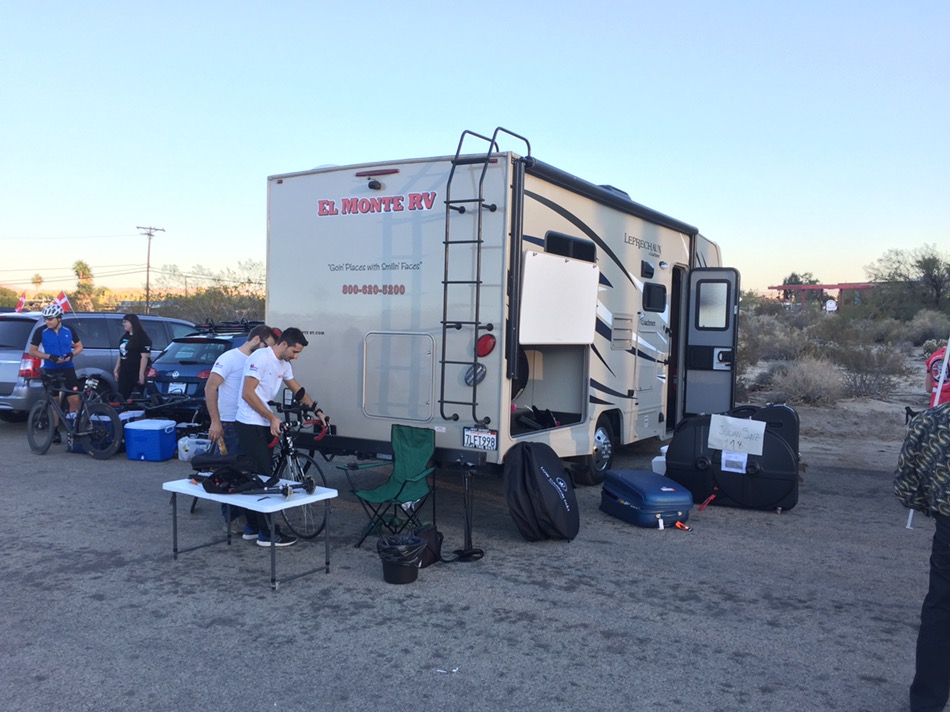
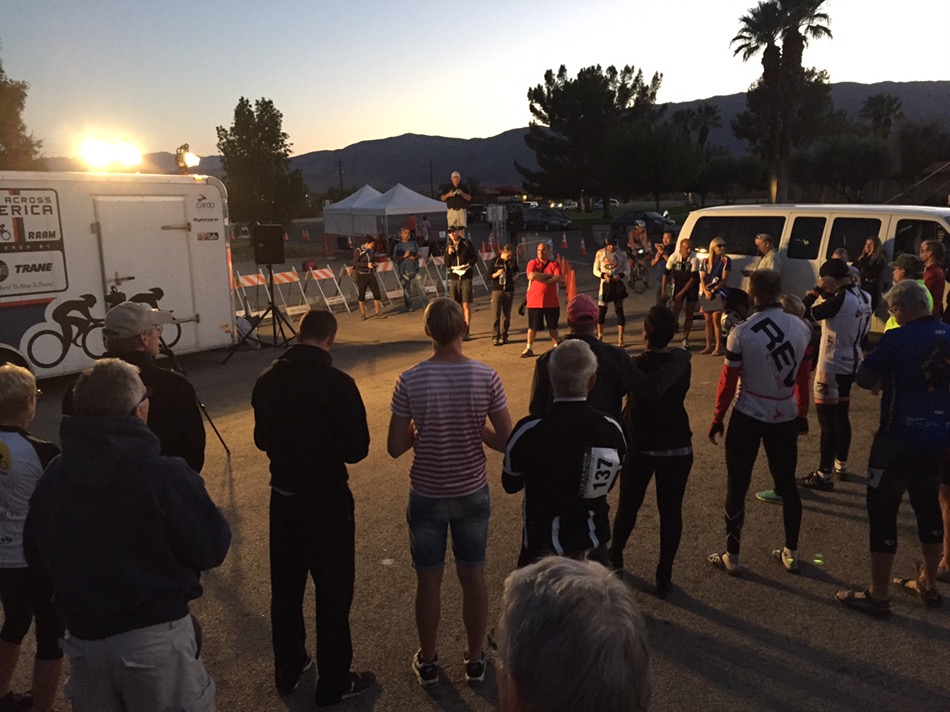
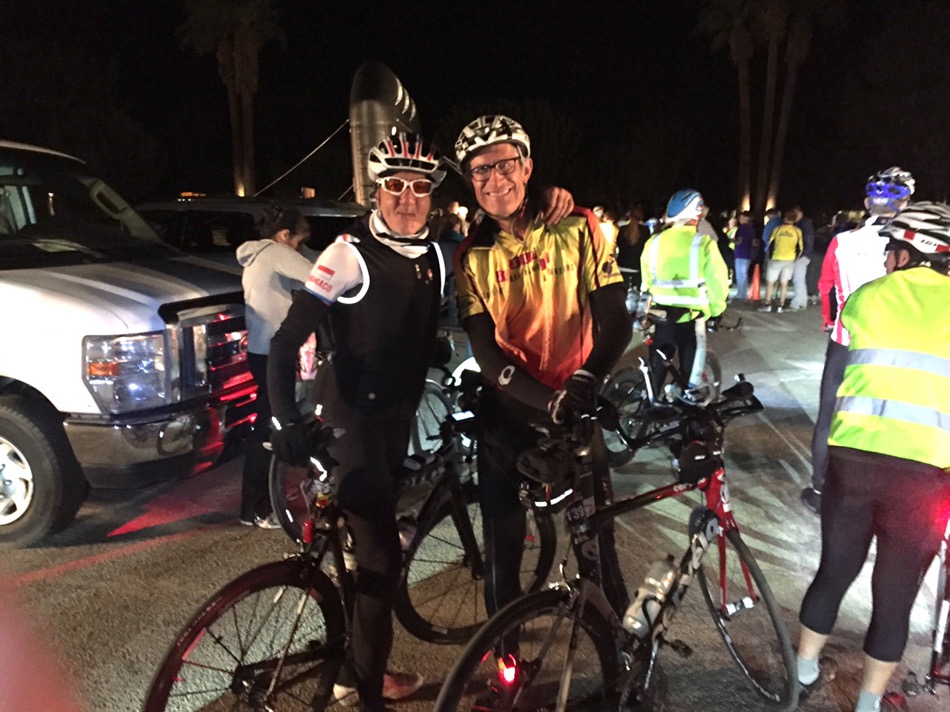
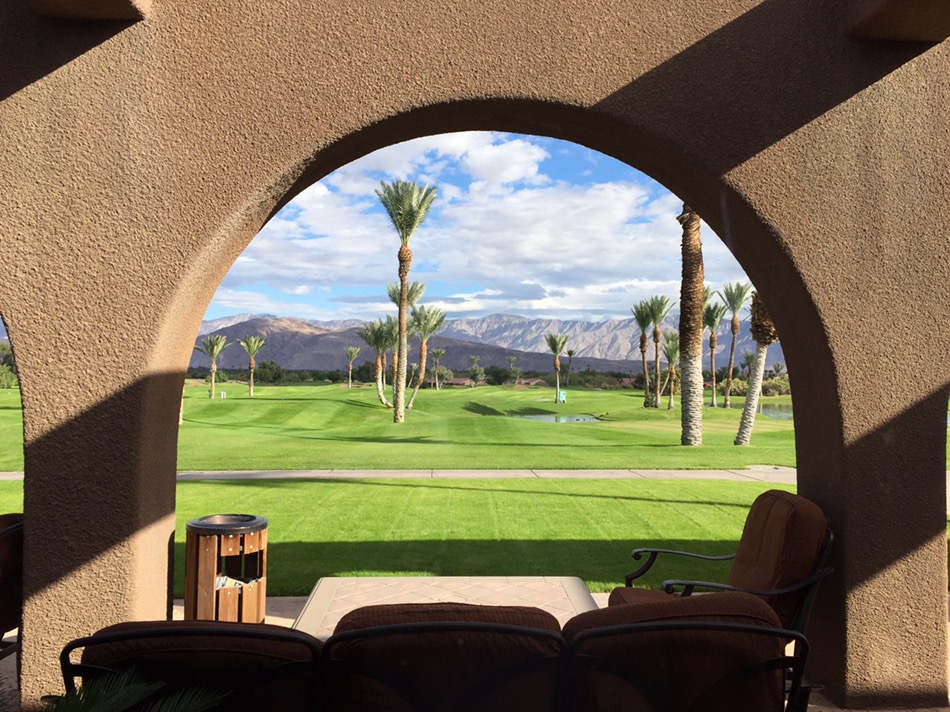
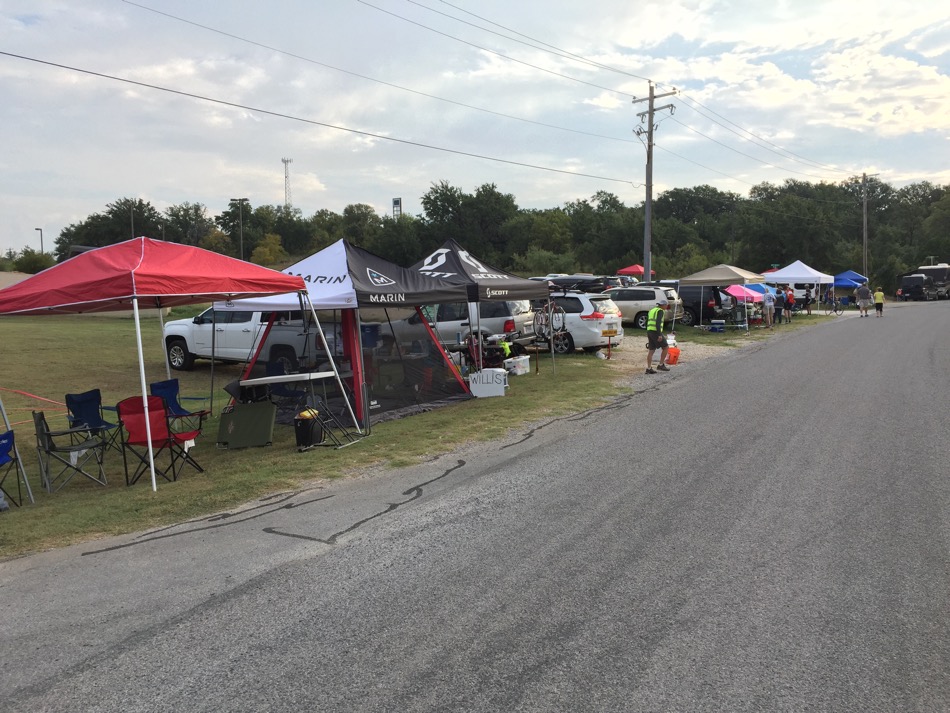
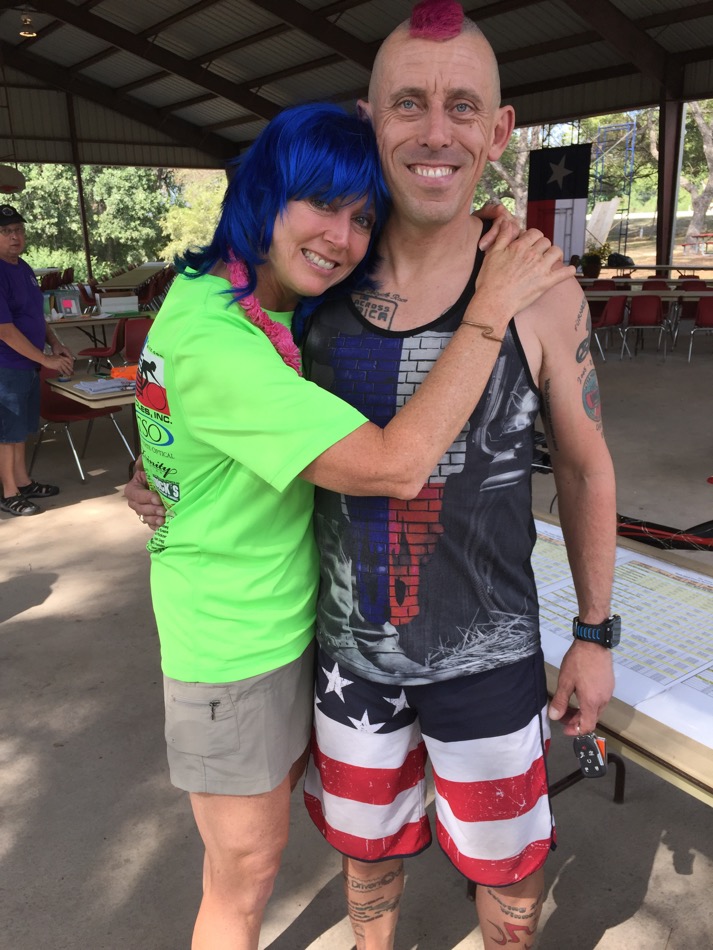
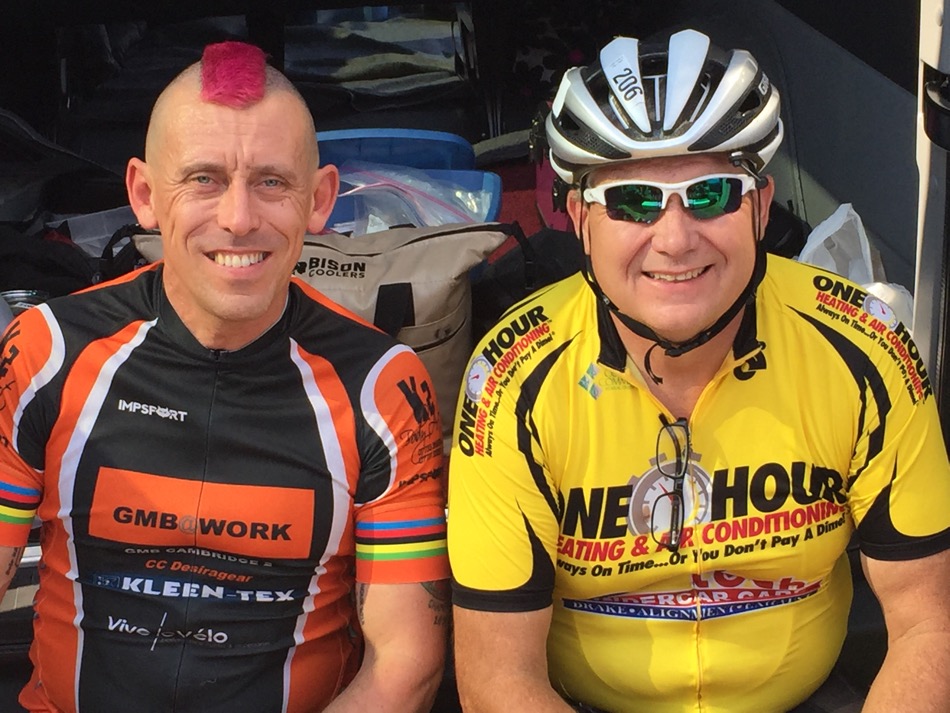
I’m not sure why they call this the “World” Championships as there are not qualifying events to get in.The numbers of the others in my age group taped to my bars. As it turns out, I only saw one of them once the whole time!Valaerio’s RV & crew.Pit rowPit rowMy pitMyself & the CerveloOpening announcements before the start.Meeting the legend: Valerio for the first time (at the start)Awards ceremony supperGeritol resultsTrinketsScott and BarbaraSunday morning breakfast view. “Oh what a relief it was” being off the bike!
Introducton
Last year (2014) I did my first 24-hour race, which was this same event, which is held in Southern California in November, about 90 minutes drive NE of San Diego. This, the World Time Trial Championships, is the last of the season in the Ultramarathon Cycling Association’s (UMCA) sanctioned events. Also offered are shorter durations including six and twelve hour divisions.
Last year, I placed second (in my age division , 60-65) to Valerio Zamboni, the legendary ultracyclist from Monaco. So this year, I really wanted to see if I improve my standing. Last year, I used a conventional carbon fiber road bike with clip-on aerobars, whereas he, and many others were using time trial bikes. I was kinda surprised how
Seven takeaways from this recently (2015) released title Fast After 50 — How to Race Strong for the Rest of Your Life. By Joel Friel, author of other best-selling books like The Cyclist’s (or Triathlete’s) Training Bible, The Paleo Diet for Athletes etc. Incidentally, he just turned 70.
I didn’t start a consistent exercise regiment, until I started running when I was in my 50s. I am now 61, so this material is SO applicable for me. I never knew what it was to “race young” as I never did any competitive sports in high school or college. Even if you don’t race, it is nice to be able to have some extra speed or strength for those tough conditions like high winds while road cycling or uphill skiing in deep powder.
“Much of what science ‘knows’ about the indicators of aging probably doesn’t apply to you. You are much less likely than your ‘normal’ neighbor to contract the lifestyle diseases of aging. You aren’t normal – and that’s good. You are continuing the active and vigorous life however ancestors. You’re an athlete.” p. 21
Training volume and intensity are both important, but intensity is the most relevant factor in maintaining a decent VO2max for older athletes. p. 35. Ned Overland, in this book, says “I’ve learned that by reducing volume, I’m more rested for high-intensity sessions, and by being rested, I can push myself harder during the intervals.” p. 114
“So far, about all science knows about exercise and aging is that there seems to be an inverse relationship between older people’s volume of exercise and the risk of premature death, regardless of the cause. In other words, the more you exercise the less likely you are to die early.” p. 43 “most people ‘rust out’ due to inactivity, rather than ‘wear out’ from being overly active.” p. 45
“The older athlete, therefore, needs more protein to ensure that there is enough to help with the rebuilding that takes place during sleep.” p. 221. He says that protein is required after any strength workout or session that stresses your muscles “such as aerobic-capacity or lactate-threshold intervals, you eat some protein within 30 minutes…” He goes on to suggest that older athletes need 40 grams after such a workout, instead of the typical 20 to 25 grams of protein that is recommended for younger athletes. p. 222
I have read in many other publications and online that the best way to burn fat is to workout at a moderate intensity, and not go “all out,” working out at or near your lactate threshold. But that has always seemed illogical to me, consequently, nearly every workout I do as at a high intensity. Joel confirms my theory and he says that very low heart rate training to burn fat is a myth that just doesn’t go away. “Low-intensity, fast-paced exercise does not burn more calories or more fat than does high-intensity, fast-paced exercise.”
He recommends year round resistance and core strength training (i.e. weight lifting). Once or twice a week is usually adequate, once you establish a base. p. 122–124 & 170-173. Strength training is also widely known to prevent or delay osteoporosis. Because of the compression of joints and spinal disks, by the age of 80, most “normal, non-athletic” people lose two inches in height. p. 19
He also mentions that if a “senior” athlete is injured or takes time away from regular training and losses his or her fitness level, it takes much longer to “get back” to where you were. Younger athletes, on the other hand, can take time off and more quickly rebound without the same quantity of days and weeks of training.
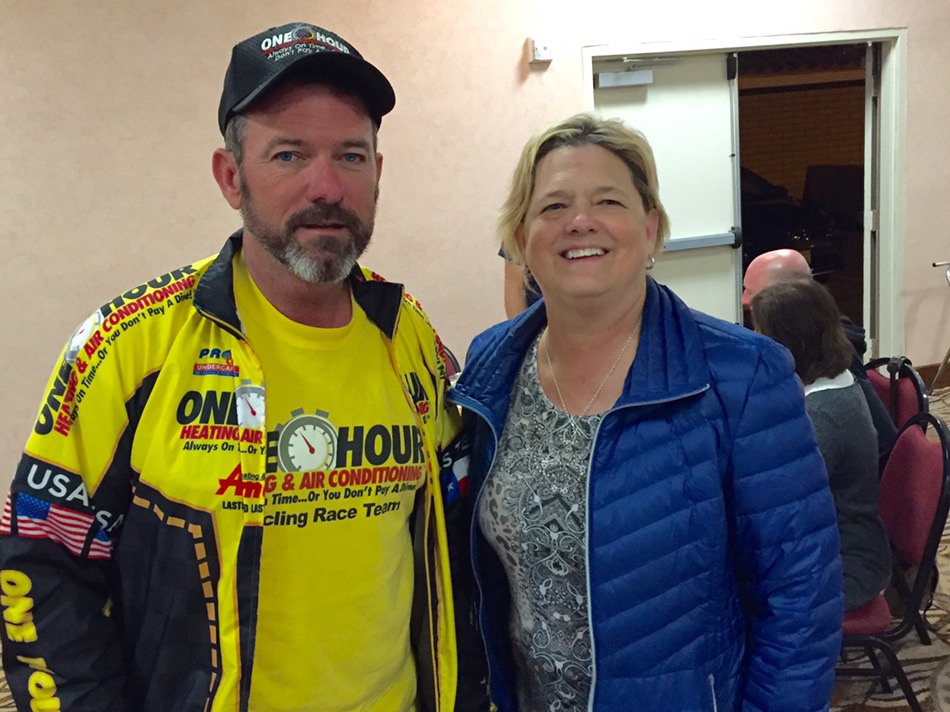
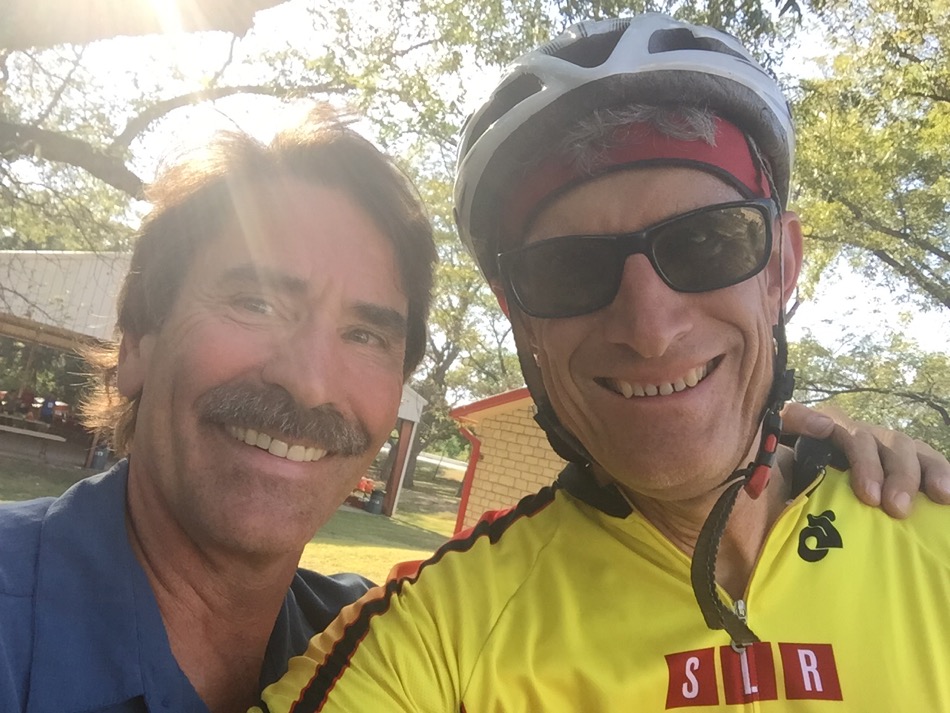
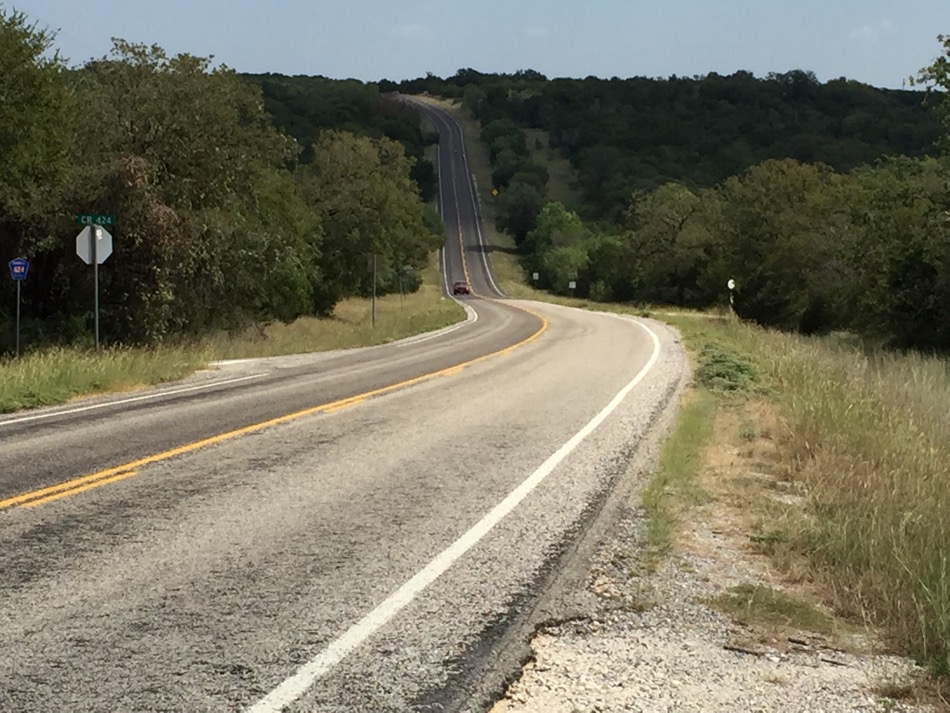
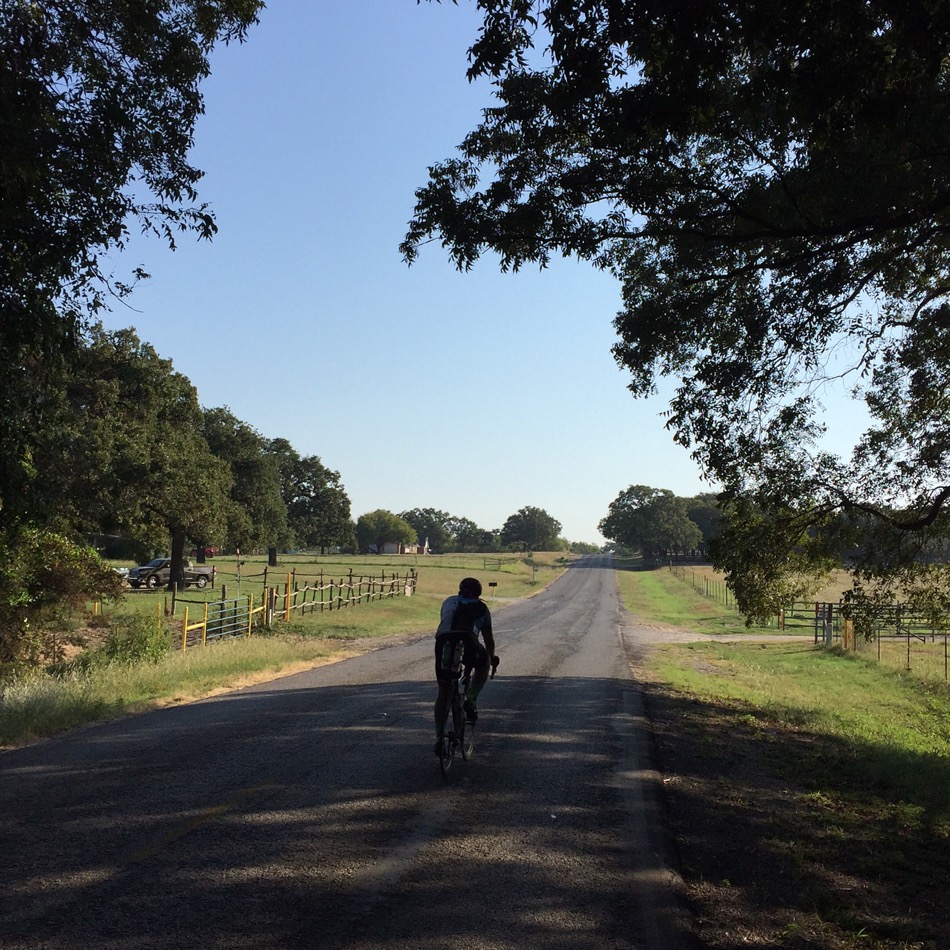
500-mile GroupDan & myselfStart/Finish LineTiming DudesMyself & Gary GotliebOpening up the bike in the motel.The pits.Pam & Chris Hopkinson “Hoppo,” who had almost 400 miles for the day. The 24-hr winner & 2015 UMCA race leader.Hoppo’s bike.Hoppo and LarryPost race smile.6% grade hill SunriseOne of the few shaded sections along the routeLittle traffic on this route
Pre-Race
On September 25th I rode my first event in Texas — the Texas Time Trials. They are hosted by Dan Discroll, who is also the RBA (organizer) of a local randonneuring group. They are put on in the community of Glen Rose, some 90-minutes SW of Dallas.
I flew in the previous day so I could get my bike assembled and make sure everything was working. This was my first experience in shipping or flying with a bike, so I was a bit apprehensive. I shipped it ahead using the service Bike Flights (via UPS Ground). The cost was about the same as flying with on Southwest Airlines — it was waiting for me at the motel, so I didn’t have to hassle with it in the airport and rental car.
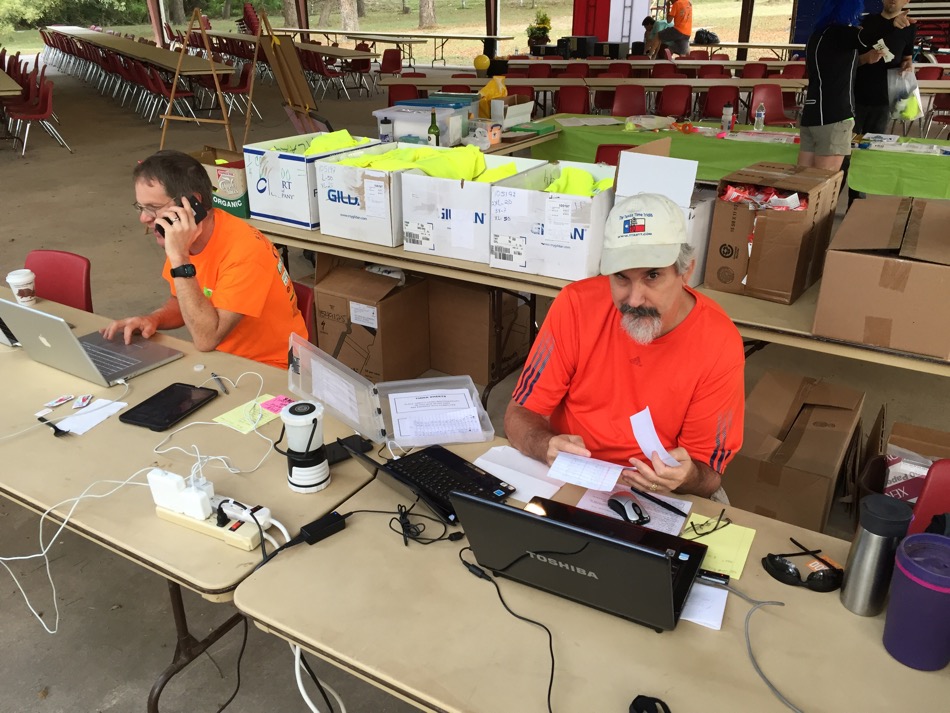
This non-drafting 24-hour “Iron Butt” race started at 5:00 p.m. on Friday. Other events started earlier or later, depending on the distance. Upon my arrival I received a warm greeting from Dan and his co-organizer, Pam Wright. I also meet volunteer Gary Gottlieb, who is a legendary distance cyclist and local randonneur.
During the day on Friday, I just chilled in the shade of the pavilion and pre-loaded electrolytes and fluids. The forecasted high was in the mid to upper 80s. Perfect weather. Since I was flying in, I prearranged to share my “pit” with a friend I met at the Texas Hotter N’ Hell show, Larry Eads. He provided me with a cooler and I was able to share his tent.
I had looked at the route ahead of time online, and unlike the other 24-hour race which I did the prior season, this one had a lot more climbing. I had a 12-30 cassette on my 10-speed carbon wheel, but the cranks were the typical time trial configuration, which is 53-39. I was a little apprehensive that this gearing may not be low enough, especially later in the race, as I tire and my strength drops. The loop was 26.4 miles with about 1200 feet of climbing.
Night Riding
The race started on time and I carried two water bottles on my bike. One on the bottle cage and a 2nd on a jury-rigged insulated pouch mounted underneath my aerobars. This necessitated stopping and pulling it out to switch as I couldn’t quite reach around far enough while clipped in. I started out with Hammer Perpeteum in my main bottle and fig newtons in my eoGEAR Century Deluxe top tube bag. My stomach was a little queasy for the first hour or two, but it later settled down. I did not have a crew person, so the idea was to stop at the “pit” every few hours, or as needed, to refill my bottles, eat solid foods and top off my top tube bag with more nutrition.
I managed to get in four laps before I ran out of fluids, so finally, after knocking out a little over a 100 miles, I stopped at the pit and topped off everything. In cooler temperatures, I find I can go a quite a distance with minimal fluids, as long as I have sufficient nutrition. The night was so comfortably warm, so that I only needed to add arm warmers. I had a wind vest stashed in my seat bag, but ended up not needing it. What a difference to riding in Utah, where the temps drop down do 40 or 50F at night in the summer or early fall. The key to night riding is to keep moving and not stop for very long, otherwise you will chill and want to put on more clothing, that may cause overheating later on. I did have to be mindful of my battery life of my front “white” light and also switch out batteries during the night. As it turns out, with my Cyglolite 740Xtra, one large and one small battery were enough to get me through the night. Since I was doing the same loop over and over again, I was able to ride with my light on the lowest setting, since I became familiar with each of the turns and stops. At one point, in the middle of the night, I did see out ahead, a “thing” cross the road — it appeared to be an armadillo, but I could not be sure. I would hate to have an encounter with one those with my skinny 25mm-wide tires!
This route had many short rollers (up to 6%) and consequently, I found myself out of the saddle on the climbs and in the aerobars on the flats and downhills, as I tried to build up speed for each upcoming hill. Consequently, I had no “Shermer’s Neck” problems because I was moving around enough on the bike and not constantly in the aero position.
Finally, Daylight
Sunrise finally came and at the first opportunity, I dumped off my lighting gear to save weight. I am rejuvenated by the sun and my pace seemed to pick up a little. Later in the day, it did get pretty hot, but I used insulated bottles and filled them with lots of ice. I don’t mind temperatures in the mid to upper 80s, as long as I can keep cold fluids going down. With the heat, I ended up stopping nearly every 26-mile lap to refill both of my bottles. At one point, I passed another cyclist who was walking his bike on a rather flat section and I asked “are you OK, need anything?” His response was “yeah, I just need a new back!”
As we rode into the city of Glen Rose, the organizers had arranged for a police officer to be at the main downtown light and wave us through, holding up traffic. That was nice as it was at the bottom of a gradual hill. I had no flats or mechanicals, so I didn’t need the roving support vehicles that cruised the route 24/7.
The Results
I just kept on doing laps and ended up rolling into the finish line with 344 miles and about 20 minutes left on the clock. This race offers no short loop option, so if I wanted to get more mileage, I would have to complete another complete lap, which was taking over 90 minutes each and they would pro-rate my mileage for the 20-minutes left. As it turns out, I was the only 60-year old in my category, so I had nobody to “beat,” and I decided to call it quits. That provided me with a 5th place overall finish, out of 18 solo guys (of all ages). 1st through 4 get a spot on the podium.
Afterwards I headed to my motel (across the street) and showered. At 7:00 p.m. was a great banquet and awards ceremony, after which I promptly proceeded to my room to catch up on some badly needed sleep.
Many thanks to Dan, Pam and their many volunteers for sponsoring such an epic event. This is the 14th year for this event. And I extend my appreciation to Larry Eads for taking me under his arm and sharing pit space and his hospitality.
After arriving home, I wrote an e-mail to Dan with the following feedback and impressions of this well-organized event. Most of it is below:
Pro:
No rumble strips on the route (they are MUCH worse than chip seal, which we also have a lot of in Utah)
No tight “dangerous” turns on the downhills. I could bomb them all, as they had decent run outs.
Blinky lights at T intersections was most helpful
Mileage markers all along the route were appreciated
Easy, common-sense reflective gear rules (not as rigid as 24-hour World’s in Boreggo Springs, CA)
End of season timing, which works for me, since I don’t usually start doing long (300K or longer) rides until May
Friday-Saturday riding with no cycling on Sunday (that is due to my Christian religious-convictions)
Con:
This course as a fair amount of climbing for a time trial event. My GPS showed 1,131 feet per lap. I wonder if you had a flatter course, that you might attract more triathletes, which would use this for training purposes (although in September, most are done for the season).
No small “end of day” loop. If you roll in with time left on the clock they allow you to finish one more lap and then pro-rate your mileage accordingly. I rolled in with 20 minutes left on the clock. Mentally, I just couldn’t deal with doing another full enchilada lap (90+ minutes)…and get such a small portion credited to me. Is doing an out-and-back with a turnaround before the Nemo climb, not feasible? With a couple of volunteers stationed there, verifying completion of laps? Too many riders to keep track of? I understand that Bessie’s Creek 24-hour race, also in Texas, has some sort of honor system for doing partial laps.
Although living in the mountains of Central Utah at 6,000 feet is not as cold as Wisconsin, it still is a constant battle when trying to road cycle during the winter months. I have heard it said on other blog posts that “if you don’t feel a little cold before starting, you are overdressed.” For backcountry skiing & running I would agree with this statement, but for cycling, I disagree. I want to feel comfortable before I clip in — this is because of the wind chilling affect once you get moving.
I found the following pieces of clothing or equipment enable me to “comfortably survive” an all day ride during these cold winter days.
Feet
I use a medium-weight merino wool/synthetic blended running sock and chemical toe warmers. Sometimes I use a taller calf-length sock instead. Originally I started out using the Planet Bike Comet Shoe covers (aka neoprene booties), but found them to be much too large and bulky, catching on my crank arm — a very poor fit and design. I have since then switched to a Pearl Izumi ELITE Softshell MTB Shoe Cover and found they work very well. I like the back Velcro closure, instead of a zipper as found in other models.
Tip #1. Don’t wear socks that are too thick as they will impede your circulation. Chemical toe warmers work great, at least for about four or so hours. Try them — use them. Consider getting a larger ”winter only” pair of cycling shoes.
In February of 2016 I purchased a pair of 45Nrth Japanther cold weather shoes. They are designed for temps of 25-45F but I bet they would perform fine in lower temps. They are totally sealed on the bottom and would be perfect for wet-weather rides when a shoe cover is not enough (after prolonger time, water can penetrate through the holes where the cleats are on conventional MTB shoes). I later sold them as they were too stiff, not allowing my ankle to flex enough. I replaced them with a pair of Fizik Artica X5 boots.
Pedals
In the winter, due to bulkier footwear, my heel rubs against my crank arms or chain stays. Also, due to a problem with my left ankle, this is exacerbated. I have started using the iSSi-brand SPD mountain bike pedals (instead of my Shimano A520s, which use the same cleat) because they offer it with a longer spindle. I prefer the +6mm model. The +12mm model is a bit overkill.
Tip #2. If necessary try a pedal with a longer spindle so you have more clearance so your foot doesn’t rub or so that your bulky winter clothing doesn’t catch on your chain.
Hands
As one that does or has done a lot of cold weather sports like mountaineering and randonnée skiing (i.e. skimo or ski mountaineering), I have an assortment of gloves and mittens. I wrote a separate post on gloves, so visit that page for more info. Essentially, I use insulated mountaineering gloves with an inner liner that is made from fleece and/or neoprene. From 2017 to 2019 I started using a pair of Pearl Izumi Men’s ELITE Softshell Gel Glove which have 100 g of Primaloft Gold insulation in them. By themselves, they worked for me with a temperature range of about 25F to 50F. I liked them so much I also started to use them for backcountry skiing.
I have a pair of the well-designed Bar Mitts, but for me they don’t work as I switch back and forth between my hoods, drops and particularly my aerobars.
Tip #3. Layer your gloves, so when the weather gets warmer, later in the day, you can jettison the outer pair, while only wearing the inside pair.
Lower Body
As is standard practice with cycling bibs or shorts with a built-in chamois, wear no undies. I like the Craft Storm Bib-Tights made with their proprietary Vent-Air fabric. This bib has a windproof fabric in the front with a more breathable and stretchy soft fabric in the back. On super cold days (15-25F) I will also layer on top of them a heavy pair of leg warmers.
Tip #6. Many times one “windproof” layer over your crotch is sometimes just not enough. Use a lightweight pair of running shorts (blue product in the photo) and slip them over your bibs. Sure, it looks dorky, but it gets the job done. Later in the day, when it is warmer and/or when my body starts putting out more heat, remove them, stashing them in an eoGEAR seat bag. This extra layer should keep your “parts” from freezing.
Tip #7. Rather than wearing long underwear, which can cause chafing, consider putting on full-length leg warmers over your tights instead for that “extra” lower extremity layer.
Head
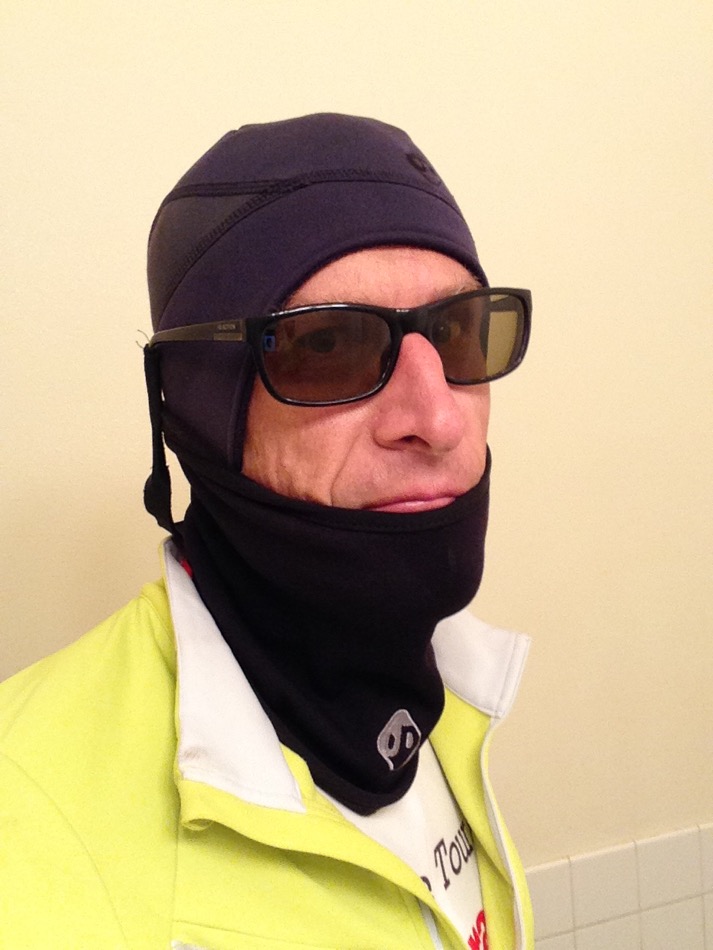
I think I have nearly every style of head covering made. This is unlike water bottles (not just for cycling, but for skimo & SUP) — I’m anal about the details and keep trying new ones till I find one that is “the one.” Because of the circumference and “over the top” measurement of my head, I’m truly a fat-head. I find it difficult to find a hat that stays down over my ears. And going 20-30 MPH on a bicycle, my ears have gotta be covered in temps lower then 50F. Currently, my favored models are from the brand Outdoor Designs from the U.K. My (for eoGEAR) primary outdoor distributor sells this brand and they are comparable to The North Face or Outdoor Research in the U.S. The cap I use is the Power Stretch Scoop with Polartec Powerstretch. Is has a stretch panel in the back providing as snug fit, yet big enough for my huge head. I then overlap it with an Outdoor Designs Power Tube neck gatior, made from the same material. I have used some hats that were simply not breathable enough (which used Polartec Windbloc) and my ears and side of my face got all wet from perspiration, which creates a whole another problem. Sometimes, underneath my hat, I have also used a thin, but very windproof ear covering called the Halo Anti-Freeze Headband, (not shown in above photos) which is made from Dryline fabric. It is very windproof, but doesn’t cause my whole head to overheat and sweat. Years ago, I originally started trying out various synthetic balaclavas but found they did not provide the same sung fit as this two- or three-piece arrangement — this is important with the higher moving speeds in road cycling, compared to MTB or gravel grinding. Besides, if it does get warmer, later in the day, I can loose a few of these layers. I prefer synthetic head products as they are thinner compare to wool, and I need to still have enough space to put on my helmet!
Tip #4. In moderate temperatures of about 50-60F wearing your glasses under your headwear is OK. They just stay put better that way, but in colder temps, it is much warmer to put them on the outside (per the above photo), so the wind doesn’t seep into your cap and freeze your ears.
Tip #5. Choose head coverings that are ergonomically designed, instead of an “ordinary looking” beanie, which hikes up and off your ears, when you look up, i.e. when you are in the drops or on aerobars. Be careful of the thickness build-up so that your helmet will still sit down properly to give you safe coverage. For that last reason, I prefer synthetic hats.
Upper Body
I generally wear a short-sleeve thin polyester base layer next to my skin (green in the photo). I don’t own any wool base-layer products, but should consider them because some synthetics can get stinky after a whole day of hard pedaling — at least the old polypro products did that. The newer polyesters are better. Over my base t-shirt I wear a mid-weight long sleeve mock turtle. Over that goes my jersey. My next layer is a skimo vest from Dynafit. It is insulated from Primaloft and has stretch side panels providing a nice tight, aerodynamic fit.
Over all that goes my “go-to” soft shell cycling jacket from Craft (neon yellow in photo). Craft, from Sweden, not only supplies apparel to cyclists, but also to nordic skiers — they know a thing or two about cold weather sports! This jacket uses their Vent-Air fabric and has just the right blend of windproofness and breathability.
There are four types of shells or jackets:
Hard shells are typically made from a thin nylon fabric with a waterproof/breathable laminate like the original GoreTex. The outside is treated is usually DWR treated to prevent water from soaking into the nylon fabric. They are designed for use in heavy or continuous rain. The best models are seam taped, meaning the sewn seams are fused together with an overlapping clear tape on the inside, so moisture doesn’t penetrate through the holes made from the sewing machine needle holes.
Soft shells, on the other hand, are designed for cold, mostly dry weather, with the possibility of a light rain. They provide a layer of insulation, unlike a hardshell which primarily just blocks the wind. Soft shells are very bulky compared to most hard shells, so if I am going to wear one, I use it on a day where I can wear it all day long and then remove layers underneath it. The big advantage of a soft shell is that it is stretchy, thus being more comfortable, especially when I am hunched over in my aerobars. I have found I can wear a soft shell with the front zip open up to temps of about 55-60F.
Hybrids are typically found on non-cycling apparel and have a hard shell waterproof/breathable fabric on the shoulders, while putting a stretchy softshell fabric elsewhere.
On more temperate days, where there is no forecast of precipitation, I will wear just a wind shell only. A wind shell is usually a jacket made from thin uncoated nylon or polyester fabric. The outer layer typically has a DWR treatment which will handle a light mist but not good in a real rainstorm. Some of the newer models use 40- or 70-denier fabric this is very lightweight and can stuff into it’s own rear pocket the size of an orange.
I also may pack a pair of arm warmers and use them when I remove my long sleeve mock turtle-neck shirt. The Pearl Izumi ELITE Thermal Arm Warmer is a good model and is thicker than other brands I have tried. I don’t care for the Pearl Izumi P.R.O. Softshell Arm Warmer — it is too thick and bulky. It is about as thick as my softshell jacket.
Tip #8. Understand the difference between different kinds of jackets, i.e. soft shell, hard shell etc. Pick the best one for your ride rather than taking two of them. The big advantage of a soft shell is that it is stretchy, thus being more comfortable, especially when one is hunched over in the drops or when using aerobars. On more temperate days, where there is no forecast of precipitation, consider using only a lightweight wind shell.
Tip #9. Consider the use of aerobars. It is much warmer when you are in this tucked position as the air literally pushes out and around your body, instead of hitting your chest and face which will cool your core.
Tip #10. Cycle with a friend or group. Drafting behind someone will increase your warmth.
Cold and Rainy Conditions
The coldest conditions I have ridden in are those nasty spring rides with lots of rain. If the low temperatures are around 35-45F and it is raining heavily for multiple hours…it can be game-over for me. I have not found the perfect solution for keeping my hands and feet warm in such conditions. I use a waterproof/breathable helmet cover, with a tail down the back to protect my neck and wear a hat that covers my ears. I suppose a pair of BarMitts would work for my hands, assuming I spent most of my time upright and not in the aerobars. But my feet? I have used thin “rain only” waterproof booties and it seems that over time, the rain will seep through, near the sole, despite a tight fit. My best solution has been using a thin (1.5-2mm) pair of neoprene socks. Maybe a pair of the insulated cycling shoes/boots might help, along with a pair of gaitors to prevent the water from entering from the top. I don’t own full length fenders for my long distance bike and I’m sure that would help.
Summary
As a randonneur, I have a goal of riding at one 200 km ride each month of the year. This generally takes all of the daylight which is available on any given day in December, so I have to move quickly to avoid any cold night riding. The rides in December, January and February are of course the roughest and necessitate the clothing and equipment mentioned above. The coldest I have ridden, with the above gear, is on day that started out at 17F and later to rose to 40F. If the forecast is colder than that, I drive 2-1/2 hours to southern Utah (or further to Las Vegas) where the elevation is lower and the temps are 20-30 degrees warmer. My biggest problem, as might suspect, is keeping my toes, hands and ears warm. I suppose I could purchase some of the winter-specific cycling shoes, but I have not yet investigated the useful temperature range of them. Keeping my fingers warm is another issue and the use of lobster-style gloves or electric-battery heated gloves would be necessary.
















 Rando Richard Blog