
A recent editorial in Bicycling Magazine reminded me of some tips for climbing.
They suggest to first scoot back on your saddle, which I already do, but they also suggested to drop your heel as your foot rotates across the top of the pedal. On mild terrain (3-5% grades) I also try to lift with my foot too, but on steeper terrain, I generally just mash.
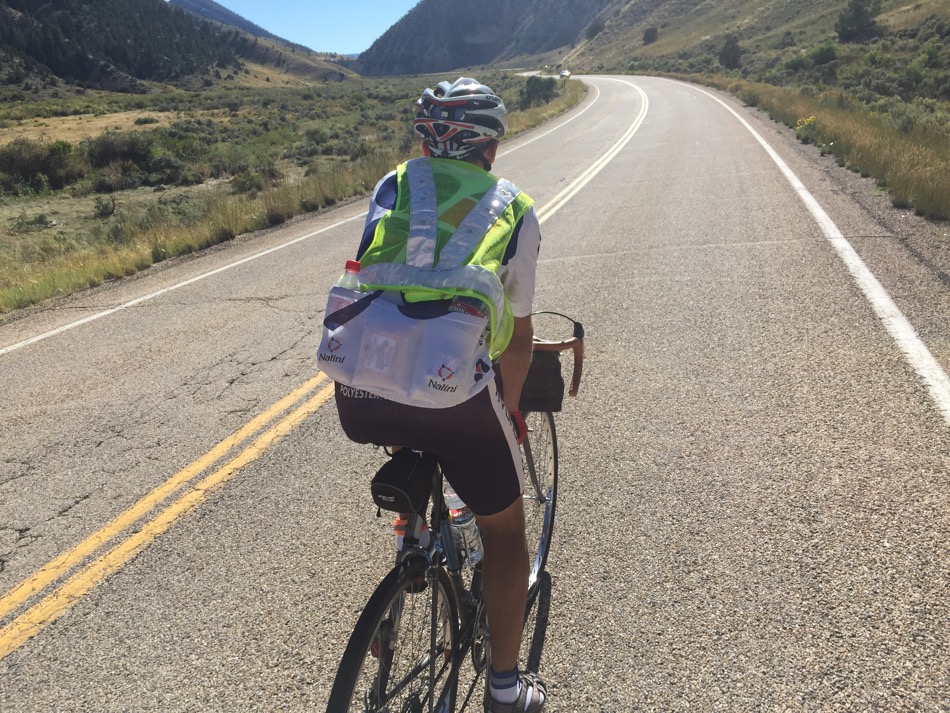
Speaking of mashing, my friend, Kenneth, as shown on a Super 600 route in Utah (600 km in 50 hours or less…375 miles with 32,000 feet of climbing) did not use clipless pedals, but rather sandals with platform pedals. He said that he likes to move his foot forward on the pedal, so his arch is right over the pedal and then mash, or just push down hard on hill climbs. There is wisdom to that because sprinters like to have their cleats mounted forward, but long distance guys, like me, have them shoved all the way back. I have even heard of some German bike fitters that put the cleats almost underneath the arch of the foot. Now I see why — on a recent hill interval workout, I wanted to pull my foot back so my arch was right over the spindle of my pedal.
Additionally, while doing steep climbs, don’t be afraid to stand up as it helps straighten out the leg and knees for additional comfort.
I also do several strength training exercises (usually twice a week throughout the year) including planks and the so-called Roman chair to strengthen my lower back, usually with a 12 to 15 pound weight in my hands.

Author: Rando Richard
I’m an old guy (age 69 in 2023) who enjoys aerobic, endurance sports. I call myself a cardio-junkie. Perhaps the more appropriate term would be “ultra” endurance sports. Since I was a teenager I have always enjoyed “slow twitch” outdoor sports like backpacking, ice climbing, running, mountaineering, hiking, alpine skiing and randonnée skiing (alpine touring, backcountry skiing or skimo). In 2005 I starting running with more regularity — except this time it was not for the intent of getting ready for a mountaineering trip, but as an end to itself. From 2005 to 2007 I managed to eek out two seasons of ultramarathons — that is competitive trail runs up to 50 or 100 miles. Due to a nagging ankle injury from the 80s (an accident while ice climbing in the 1980s where my lower tib and fib were badly broken), I had to cease that grueling, but rewarding activity. I then migrated into ultra distance road cycling or randonneuring. The rides are called brevets (pronounced bruh-VAY, it’s French) and are minimally supported — they are similar to ultrarunning and backpacking where one must be self reliant. Although brevets are non-competitive, they do have have cut off times to qualify as a finisher. They are usually are done in groups, which can have a competitive slant to them. Today, I continue to participate in long distance cycling including some ultra-racing, randonnée skiing (a blend of cross country and downhill disciplines) and still get out on an occasional mountaineering trip.
Since 1996 I have been designing, manufacturing and selling camera bags. That is Kinesis Photo Gear (kgear.com). In 2005 I started selling cycling bags under the Kinesis label and eventually expanded it to including other sports like SUP (stand-up paddle boarding and some skimo). Consequently, it become eoGEAR — the “eo” stands for endurance outdoor.
My wife and I are empty-nesters now and we live and work out in the boondocks of central Utah, half way between Salt Lake City (great powder) and Moab (great red rocks).
Well, I guess that is all for now. Safe travels mate! Perhaps I’ll see you on the road or trail.
— Richard Stum
View all posts by Rando Richard
 Rando Richard Blog
Although I do like the ability to lift (pull) up on the flats the more I ride the more I prefer platform pedals. Not only does it permit your foot to move around but my adjusting your tibia / foot position you tend to take strain off the knees.
Standing is VERY important as it straightens the back / changes the knee loading. I usually stand for a count of 25 or 30 at most unless the slope exceeds 10 percent in which case I usually have to stand.
LikeLike
And on the flip side, when spinning fast, I like to slide my foot back so my toes are on the pedal. Don’t know why, it just “feels” right.
LikeLike