Richard Stum’s randonneur cycling, rando skiing & SUP site. @rando_richard
Calibrating non-GPS Cyclocomputers
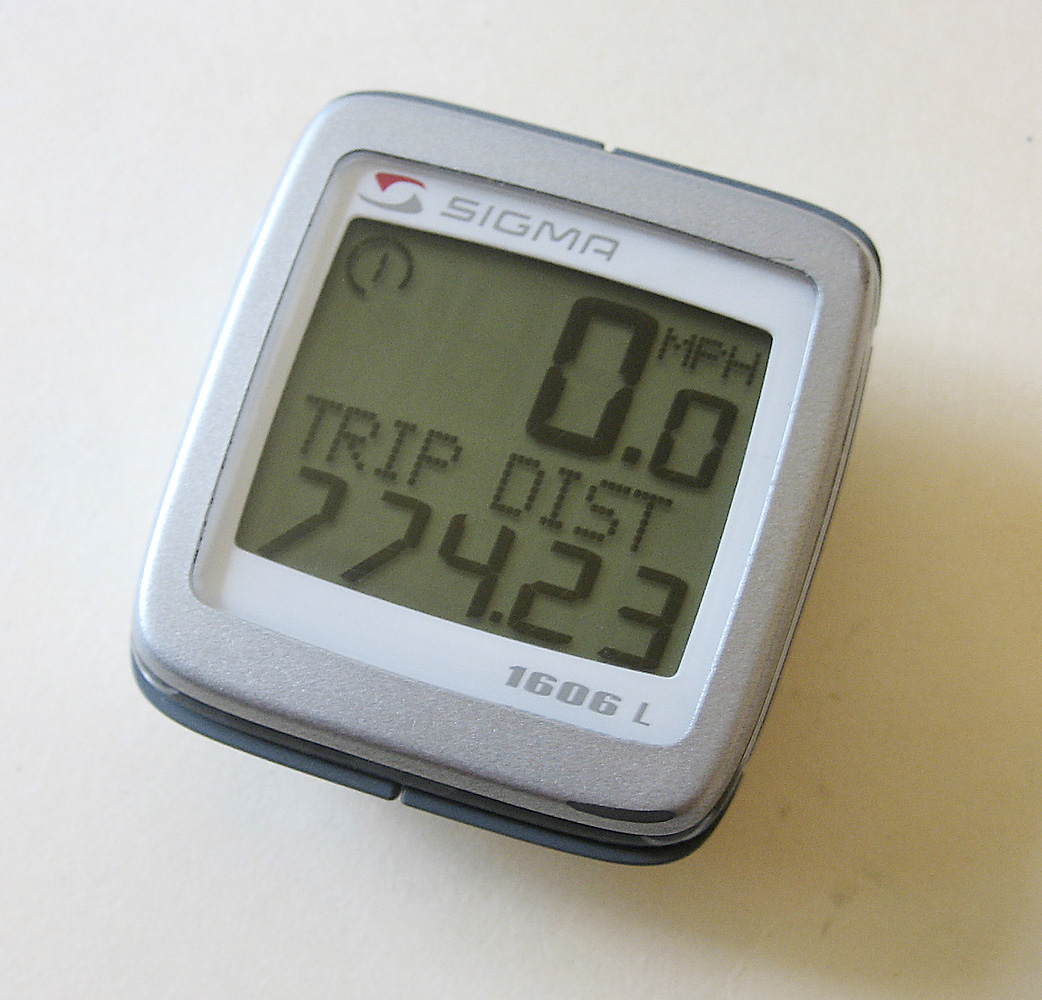
My Sigma 1606L at the end of 4 days on ”Last Chance.“ Thats a lot of miles for one ride!
Calibrate your bike computer (or cyclocomputer) so it is accurate—unless you have a GPS-based model. On my first brevet, my computer was so far off, that it was a major factor in my DNF (darkness, rain, sleet and a tiny bit of snow didn’t help either). To calibrate it you must know how to change the wheel size in the computer. Not all wheels are the exact same circumference. A 700 x 25c tire between brands can vary enough that during a 125-mile brevet you might be a mile or two off at the end of the day. Use a GPS to calibrate. Borrow one from a friend if you need to. I have a Garmin designed for hiking and generally don’t use it for cycling (too heavy & eats batteries like crazy). Don’t use an automobile odometer—they are all over the map.
Here’s how: Zero out the mileage on the computer & GPS. If necessary, put the GPS in your back pocket so it gets a clear shot of the sky for accuracy. Ride for 4 or 5 miles and compare the two. If the bike computer reads high, then you need to reduce the wheel size. Or visa-versa. Then ride several more miles and check it again. It may take several calibration attempts. It is simply trial and error. Finally, ride for 10–20 miles and check. I try to get mine to read within 0.1 mile accuracy for a 15 mile distance.
Don’t do this in mountainous terrain or a steep climb as some GPS models have trouble there. I have found that with my Sigma computer, I use 2110mm for Maxxis 700 x 25 ReFuse tires and 2113mm for Conti. 700 x 25 Gatorskins.
I’m an old guy (age 69 in 2023) who enjoys aerobic, endurance sports. I call myself a cardio-junkie. Perhaps the more appropriate term would be “ultra” endurance sports. Since I was a teenager I have always enjoyed “slow twitch” outdoor sports like backpacking, ice climbing, running, mountaineering, hiking, alpine skiing and randonnée skiing (alpine touring, backcountry skiing or skimo). In 2005 I starting running with more regularity — except this time it was not for the intent of getting ready for a mountaineering trip, but as an end to itself. From 2005 to 2007 I managed to eek out two seasons of ultramarathons — that is competitive trail runs up to 50 or 100 miles. Due to a nagging ankle injury from the 80s (an accident while ice climbing in the 1980s where my lower tib and fib were badly broken), I had to cease that grueling, but rewarding activity. I then migrated into ultra distance road cycling or randonneuring. The rides are called brevets (pronounced bruh-VAY, it’s French) and are minimally supported — they are similar to ultrarunning and backpacking where one must be self reliant. Although brevets are non-competitive, they do have have cut off times to qualify as a finisher. They are usually are done in groups, which can have a competitive slant to them. Today, I continue to participate in long distance cycling including some ultra-racing, randonnée skiing (a blend of cross country and downhill disciplines) and still get out on an occasional mountaineering trip.
Since 1996 I have been designing, manufacturing and selling camera bags. That is Kinesis Photo Gear (kgear.com). In 2005 I started selling cycling bags under the Kinesis label and eventually expanded it to including other sports like SUP (stand-up paddle boarding and some skimo). Consequently, it become eoGEAR — the “eo” stands for endurance outdoor.
My wife and I are empty-nesters now and we live and work out in the boondocks of central Utah, half way between Salt Lake City (great powder) and Moab (great red rocks).
Well, I guess that is all for now. Safe travels mate! Perhaps I’ll see you on the road or trail.
— Richard Stum
View all posts by Rando Richard

 Rando Richard Blog