Richard Stum’s randonneur cycling, rando skiing & SUP site. @rando_richard
Leg Length Inequality
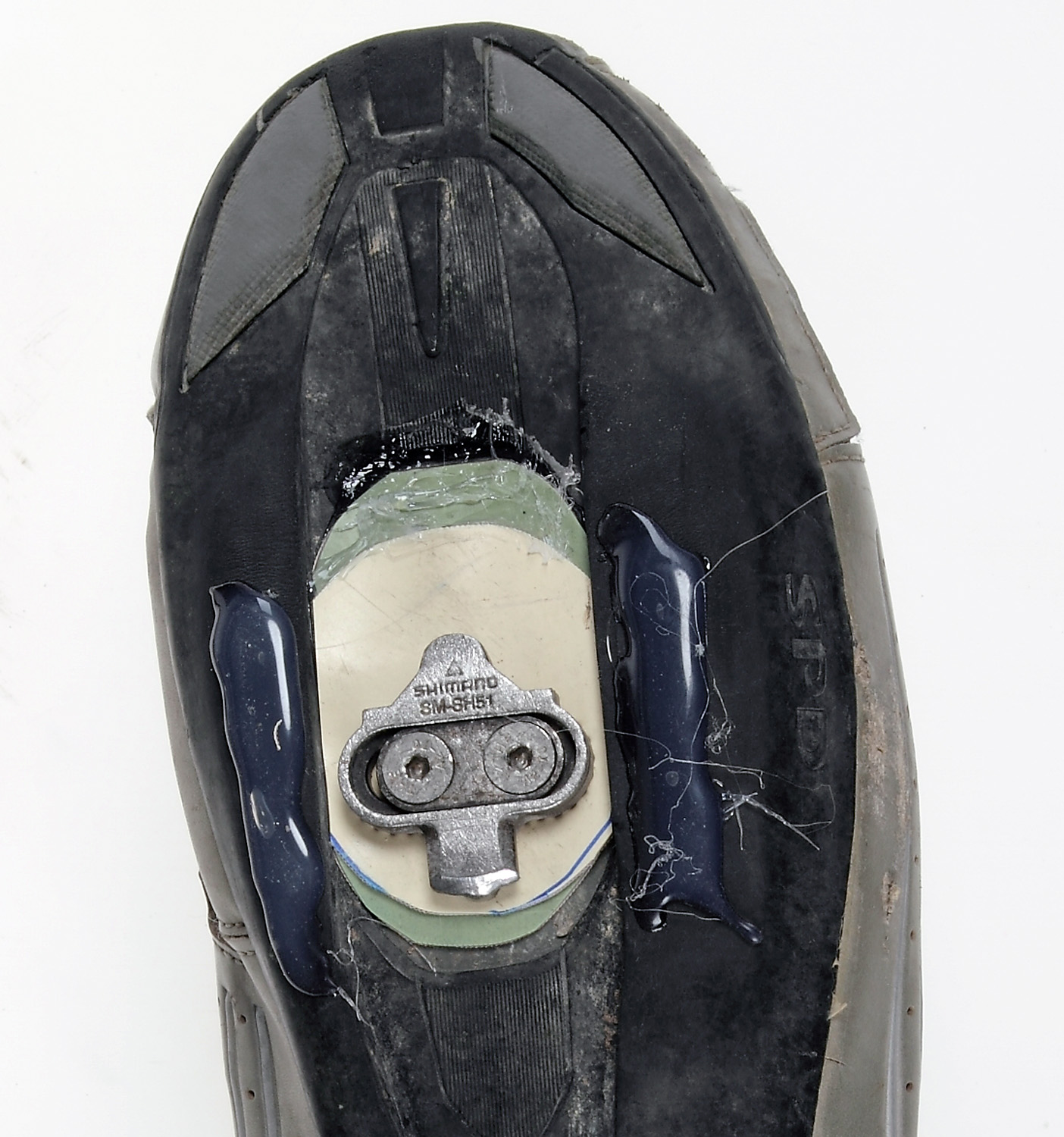
Homemade shim for my MTB cleats on my Shimano “Touring” shoe. I also put strips of hot glue on the side to elevate the sole of the shoe.
During the 2010 cycling season, while trying to find the ultimate saddle for cycling, I constantly had chafing issues, but ONLY on my right side, just forward of my sit bone. After reading Pruitt’s Complete Medical Guide for Cyclists about leg length inequality (p. 69), I had my legs measured. I went to a trusted friend, who is physical therapist. Using a tape measure he determined that my left leg was 10 to 15mm (1/4 to 3/8″) shorter than my right leg. That seemed to make sense, as my left ankle is my “bad” ankle that has suffered a major break in a mountaineering accident (1984) and has had subsequent surgeries, including a bone graft to build up the length of the leg. But would a shorter left leg contribute to soreness on my right side? Weird.
Since then, I have shimmed up my left shoe. I first used a custom orthitcs in my left shoe only, which gives me a little more lift than the stock insole which I have in my right shoe. Initially I used a couple of sheets of HDPE (plastic), but the cleat kept rotating loose, so now I have placed two layers of 1.5 mm semi-firm rubber there (used on drafting tables as cutting pads). Pruitt suggested that you shim up only half the distance of your LLI and then, only if your LLI is more than 3mm.
Time will tell. Meanwhile, I am in the midst of testing various saddles, to it may be hard to tell if this made much difference.
I’m an old guy (age 69 in 2023) who enjoys aerobic, endurance sports. I call myself a cardio-junkie. Perhaps the more appropriate term would be “ultra” endurance sports. Since I was a teenager I have always enjoyed “slow twitch” outdoor sports like backpacking, ice climbing, running, mountaineering, hiking, alpine skiing and randonnée skiing (alpine touring, backcountry skiing or skimo). In 2005 I starting running with more regularity — except this time it was not for the intent of getting ready for a mountaineering trip, but as an end to itself. From 2005 to 2007 I managed to eek out two seasons of ultramarathons — that is competitive trail runs up to 50 or 100 miles. Due to a nagging ankle injury from the 80s (an accident while ice climbing in the 1980s where my lower tib and fib were badly broken), I had to cease that grueling, but rewarding activity. I then migrated into ultra distance road cycling or randonneuring. The rides are called brevets (pronounced bruh-VAY, it’s French) and are minimally supported — they are similar to ultrarunning and backpacking where one must be self reliant. Although brevets are non-competitive, they do have have cut off times to qualify as a finisher. They are usually are done in groups, which can have a competitive slant to them. Today, I continue to participate in long distance cycling including some ultra-racing, randonnée skiing (a blend of cross country and downhill disciplines) and still get out on an occasional mountaineering trip.
Since 1996 I have been designing, manufacturing and selling camera bags. That is Kinesis Photo Gear (kgear.com). In 2005 I started selling cycling bags under the Kinesis label and eventually expanded it to including other sports like SUP (stand-up paddle boarding and some skimo). Consequently, it become eoGEAR — the “eo” stands for endurance outdoor.
My wife and I are empty-nesters now and we live and work out in the boondocks of central Utah, half way between Salt Lake City (great powder) and Moab (great red rocks).
Well, I guess that is all for now. Safe travels mate! Perhaps I’ll see you on the road or trail.
— Richard Stum
View all posts by Rando Richard

 Rando Richard Blog