Richard Stum’s randonneur cycling, rando skiing & SUP site. @rando_richard
2010 Cascade 1200K Randonnée (770 miles in 3-1/2 days)
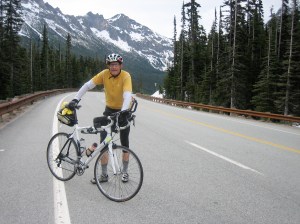
Day 4. Washington Pass, elevation 5477 feet, our high point of the ride.
This randonnee starts and finishes in Monroe, a town at the western base of the Cascades, some 40 miles N.E. of Seattle. The route essentially makes a gigantic counter-clockwise loop around Mount Rainer. This 1200km event is sponsored by one of the largest randonneuring groups in the U.S., the Seattle International Randonneurs or S.I.R. (This randonnee is actually 1240km or 770 miles with about 40 to 43,000 feet of climbing). Some 90+ riders took this challenge from June the 26th through the 30th.
Two years ago I attempted this ride — it was my first 1200K. I had been riding a road bike for less than a year then so I was rather new to the sport of randonneuring. I dropped out after day three and 600 miles due to saddle sore issues. This event is held every other year, so this year I had a score to settle. We are allowed 93 hours to finish, which is almost four days and three nights. The ride started on 6:00 a.m. on a Saturday and we had to be in by 3:00 a.m. on Wednesday to qualify as a finisher. In the previous two times this event took place, the completion rate was between 68-71%. This time (primarily because of the nicer, not-so-hot weather), the completion rate was closer to 80 or 85% I believe.
Many thanks to the volunteers of S.I.R. for their hours of preparation and tireless service. Oh yeah, thanks also to those unnamed riders who pulled me along during various parts of this ride.
A few stats of the ride: Day 1, Monroe to Naches: Mileage was 224 with an average moving speed for the day of 16.85 MPH (not taking into account breaks). I left Monroe at 6 a.m. and arrived at 8:35 p.m. Calories consumed during that time was 6365 with a maximum heart rate of 152 BPM (my absolute threshold is 163 on a bike, and 172 on skis). My heart rate during the two hour climb up to White Pass was essentially sustained at 137 BPM (which is the red zone or upper 20% for me) for that period of time. Day 2, Naches to Quincy: Mileage was 206 with an 2-day accumulated average moving speed of 16.0 MPH. I left the overnight stop at approx. 3:30 a.m. and arrived at 8:49 p.m. I had less climbing that day, but due to the mechanical problem with my bag (as a result of a crash) I lost several hours of time. Calories consumed during that time was 3306 with a maximum heart rate of 132 BPM. Day 3, Naches to Mazama: Mileage was 180 with an 3-day accumulated average moving speed (to date) of 15.5 MPH. I left the overnight stop at approx. 5:20 a.m. and arrived at 8:13 p.m. Calories consumed during that time was 2703 with a maximum heart rate of 129. My heart rate going up Loup Loup Pass was at a sustained rate of about 115 BPM. Day 4, Mazama to Monroe: Mileage was 162 with a 4-day accumulated average (final) moving speed of 15.24 MPH. I left the overnight stop at approx. 5:45 a.m. and arrived at the finish at 7:39 p.m. My heart rate monitor watch got switched off as a result of wearing a jacket on the descent so I have no record of that day’s heart stats. I observed that my sustained heart rate while ascending Washington Pass was in the range of 110–115 BPM. My Total time including riding, resting, sleeping and eating was 85 hours and 39 minutes. My pedaling or moving time (sometimes I coast the downhills which registers as movement with my cyclocomputer) was 51 hours, 17 minutes. My average cadence was 71. My maximum speed was 41.3 MPH. Please note that on the last morning of this brevet, a nice buffet breakfast is provided at Mazama at 5:00 a.m., which is a big deterrent for an early start to grab a good “finishing time.” I choose to stay for the breakfast and use that energy for the long climb that morning. Notes About Sleep I have found that on 1200k’s I like to set a goal to arrive at each overnight stop by sunset, leaving at whatever time in the morning is needed. Sometimes, that means leaving at 3 or 4 a.m. and perhaps taking a nap along the way. One thing I have learned about 1200k’s…speed = sleep. The faster you can move on the bike, the more sleep you can obtain — this simple fact was a driving force during my spring training. As a solid eight-hour-a-night guy (plus occasional naps…I’m self employed and work at home), sleep was high on my list. The funny thing about this randonneé is that despite arriving at the overnight control by sunset each night, I only slept well one night. The first night, I didn’t have earplugs and it was too hot for me (I finally just got up and started down the road at about 3:30 a.m.). I procured some earplugs for night two (thanks Mike Sturgill) and slept OK in Quincy. Night three in Mazama I was too hot again and slept poorly. Perhaps my heart rate is not dropping down low enough at night and my body remained overheated? (My normal resting rate before climbing out of bed is 42 BPM). I took my heart rate monitor off at night. Next time I think I’ll leave it on and see what it says as I retire. Or next time maybe bring a foam pad and sleep outside where it is cooler?
Do two click-throughs to see the photos enlarged.
The photos are in chronological order, left to right.
As with most group rides, there was a nice peleton at the beginning and then as we hit the first few hills, things begin to thin out. I was hoping I could make it to the overnight control before dark. But that was 224 miles out. Would that be possible, especially with the big climb over White Pass near the end? (Excuse the fussy image…low light conditions!)
Nice cool, but not cold and overcast conditions towards the first control.
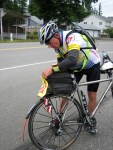
Ken Bonner making some adjustments at mile 53. I never saw him again on the road as he stayed well ahead of the group. Rumor has it, he was shooting for a sub 60-hour time.
Mount Rainer from Eatonville at about mile 96. It was here that I caught up to my Ariz. friend Mike Sturgill and he and I rode together for the balance of the day.
Tourist trap in Elbe I believe.
John Pearch with Rainer in the background. John and I spent some time riding together as he, like me, is a “former” ultrarunner, but due to injuries, is now on a bike.
Mike Sturgill and Rainer. He was the winner of the 2008 Hoo Doo 500, a grueling rando race in Southern Utah.
Killer scenery on this ride.
Mount Rainer again
Mount Adams in the distance.
We had stunning weather at this event. The highs were in the mid 80s with the lows in the low 50s. I had a few dozen rain sprinkles during the last 10 miles, otherwise it was a dry ride.
Towards the end of day one, we climbed from 1066 feet in Packwood to White Pass, which is 4500 feet.
View on the way up White Pass.
The grade on White Pass was very consistent, which I like. I got into a ryhthm and did this 3400 foot cliimb, not letting my speed drop below 7.5 MPH.
Continuing up the pass.
Don‘t just look ahead on climbs. The reverse views can be stunning too. Mike Sturgill with Mount Rainer in the distance.
Finally the top, after about two hours of steady climbing. The last time I did this ride in 2008, I arrived at dusk and put on my reflective gear. This year it was nice to have the warmth of the sun on top. And yes, Mike and I did make the first overnight control just before dark.
The legendary Ken Bonner kindly obliged this photo op for me. He is literally the Lance Armstrong of randonneuring. This was at the first overnignt control Naches. I believe he was stopping in for food and to get his brevet card signed, but not sleeping like most others.
DAY TWO dished out 206 hot miles. This is at the Lodgepole Control. I neglected to bring my ear plugs and the sleeping quarters at the first overnight control were very hot. I think I slept only an hour or two, so at 1:30 a.m. I got up, had a little breakfast and was on the road by about 3:00 a.m.
The mighty Columbia River on day two. Day two had the least appealing scenery and turned out to be very long for me.
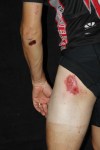
Road rash. Click photo for the back story.
Rolling into the overnight control in Quincy after a VERY weary day. My goal was to arrive at each overnight stop before dusk.
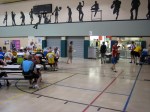
Quincy High School cafeteria.
The SIR volunteers did bang-up job of provided evening and morning meals at the ovenight stops.
The morning of DAY THREE. Vincent Muoneke at Lenore Lake, near the Dry Falls Control.
Vincent and I did our first 1200K in 2008 (Last Chance Colo.). Last year he set a new RUSA mileage record. He has one iron butt and a HUGE smile.
Farmer control in the middle of nowhere on day three.
Looking back to the Farmer Control. We caught a nice tail wind through this section.
The Columbia river and the Chief Joseph Dam near Bridgeport.
Many orchards are found on the east side of the Cascades.
This is pretty view near the false summit of Loup Loup Pass. This climb had more variable grades than the other passes we crossed. As this was day three, my typical speed for most of the grade was 6 or 7 MPH, instead of 7 or 8 as was the case on White Pass on day one.
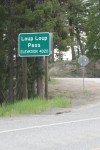
Caution sign at Loup Loup summit.
In 2008 I went over this pass in the middle of night and I was walking much of it due to saddle sores.
Lush valley near the town of Mazama.
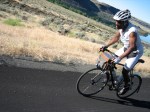
Another roadie near Mazama.
Sunset near Mazama.
Chill out time at Mazama.
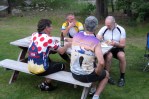
Kieth Nichol (L), Bob Bruce (R), Greg Courtney (sleeveless) and others catching up on war stories over supper.
Mazama Ranch house
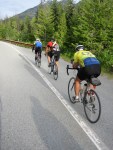
FINALLY, DAY FOUR BEGINS! Only 162 miles to go. I love this shot as it has Kerin Huber pulling three of us guys up towards Washington Pass. There was a slight head wind as we made this 3300-foot ascent.
I slept very poory on nights one and three — click for the back story.
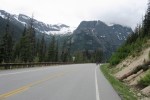
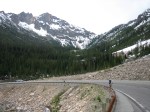
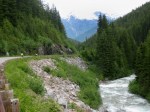
Wow, could we ask for better vista views?
Approachng the hairpin turn before the summit if Washington Pass.
Looking down the final turn before the pass.
Finally, most of the climbing is done for the ride!
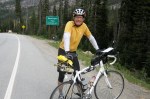
Day 4. Washington Pass, elevation 5477 ft. Our high point of the ride.
Yutaka Moriwaki of Japan was one tough rider. Here he is layering up on the top of Rainy Pass summit (4855 ft).
View coming down the west side of the Cascades. Regretfully we had a headwind most of the distance.
Diablo Lake
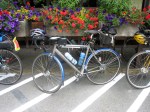
Various bike types
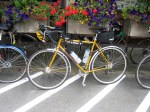
More styles of bikes.
The last 120 miles was a VERY tough go for me. Click the photo for the back story.
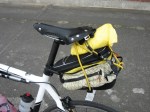
My bungy-corded bag (post crash fix).
Now that is the kind of saddle I need.
Post ride breakfast of champions in Monroe.
Another breakfast shot. I finished the night before at about 7:40 p.m. As you might expect, the motel bed was ONE welcome site that night.
I’m an old guy (age 69 in 2023) who enjoys aerobic, endurance sports. I call myself a cardio-junkie. Perhaps the more appropriate term would be “ultra” endurance sports. Since I was a teenager I have always enjoyed “slow twitch” outdoor sports like backpacking, ice climbing, running, mountaineering, hiking, alpine skiing and randonnée skiing (alpine touring, backcountry skiing or skimo). In 2005 I starting running with more regularity — except this time it was not for the intent of getting ready for a mountaineering trip, but as an end to itself. From 2005 to 2007 I managed to eek out two seasons of ultramarathons — that is competitive trail runs up to 50 or 100 miles. Due to a nagging ankle injury from the 80s (an accident while ice climbing in the 1980s where my lower tib and fib were badly broken), I had to cease that grueling, but rewarding activity. I then migrated into ultra distance road cycling or randonneuring. The rides are called brevets (pronounced bruh-VAY, it’s French) and are minimally supported — they are similar to ultrarunning and backpacking where one must be self reliant. Although brevets are non-competitive, they do have have cut off times to qualify as a finisher. They are usually are done in groups, which can have a competitive slant to them. Today, I continue to participate in long distance cycling including some ultra-racing, randonnée skiing (a blend of cross country and downhill disciplines) and still get out on an occasional mountaineering trip.
Since 1996 I have been designing, manufacturing and selling camera bags. That is Kinesis Photo Gear (kgear.com). In 2005 I started selling cycling bags under the Kinesis label and eventually expanded it to including other sports like SUP (stand-up paddle boarding and some skimo). Consequently, it become eoGEAR — the “eo” stands for endurance outdoor.
My wife and I are empty-nesters now and we live and work out in the boondocks of central Utah, half way between Salt Lake City (great powder) and Moab (great red rocks).
Well, I guess that is all for now. Safe travels mate! Perhaps I’ll see you on the road or trail.
— Richard Stum
View all posts by Rando Richard
3 thoughts on “2010 Cascade 1200K Randonnée (770 miles in 3-1/2 days)”
Congratulations, Richard. This is fantastic!
I want to hear about your accident. What happened?

























 Rando Richard Blog
Congratulations, Richard. This is fantastic!
I want to hear about your accident. What happened?
Susan
LikeLike
Hi Susan,
Click on the photo and it will bring up the same photo again and the “back story.” Click on the 2nd photo again and it will enlarge.
LikeLike
Great post on the 1240K brevet.
Formally I hiked in the Cascades. Now I will be preparing for the 2012 running of this brevet.
Bob
LikeLike